The grill doesn't care what pellets you put in it. The meat does. I've been running Traeger Grills 100% All-Natural Wood Pellets as my baseline across four pellet grills and twenty years of cooks, and I've watched hardwood pellets make or break a bark more times than I can count. This guide is what I actually reach for in the hopper when I'm cooking brisket, pork shoulder, ribs, chicken, fish, and turkey, plus the cheap mistakes I've learned not to repeat.
Why you should trust me
I've been smoking meat for twenty years and judging KCBS competitions for fourteen. I keep a logbook with every cook, every pellet brand, every outside temp, every wind condition, and every hold time. My garage is a two-car smoker hospital where neighbors bring their broken units, my dog Sarge sleeps on the deck right by the smoker during long cooks, and my wife tolerates mild smoke flavor only. That constraint has shaped more of my pellet choices than any competition trophy. When I tell you apple and cherry are the wife-friendly woods, it's because she actually asked for seconds.
How I picked and how I tested
I tested pellets across four pellet grills over the last two years, including a big freestanding unit, a portable tabletop in the RV, and two others I'm not putting on the bench today. I ran each pellet type on at least three cooks: a 14-hour pork shoulder, an 8lb shoulder on a budget unit with a small hopper, and a quick test like a 3lb poor man's brisket or chicken thighs. I logged set temp, ThermoPro-measured temp, pellet consumption, and final bark and smoke ring. I also pulled real buyer complaint patterns from the Amazon corpus to cross-check what I saw on my own graphs. If three separate verified buyers report the same auger jam or ash issue with a brand, I pay attention, because that pattern shows up in my logbook too.
One thing I want to get out of the way early: a wet pellet is a jammed auger waiting to happen. I store every bag in Mighty Tuff 5-gallon buckets. If you've ever had your auger seize up at 2 AM on a 14-hour cook, you don't forget it.
Traeger Grills 100% All-Natural Wood Pellets
The benchmark. Every other pellet is compared against it.
Price climbs fast if you're running a 21lb turkey or a 14-hour shoulder.
Pellet Grill Cover for Traeger Pro 22/575 Series, 1000D Heavy Duty
Protects the hopper and electronics from the rain that wrecks pellets.
Sized for the Pro 22 and 575 only. Measure your grill first.
Comnova Grill Cover for Traeger Pro 22 & 575 Series
Solid 600D build at a fair price.
Not the thickest material on the market.
1000D Heavy Duty Grill Cover for Traeger Pro 22/575 Series BAC503
Backup cover worth keeping around.
Redundant if you already own one.
24 in. WIFI Woodwind Pellet Grill & Smoker
The upgrade pick for owners who want WiFi and Bluetooth logging instead of a paper logbook.
Costs roughly four times a budget grill.
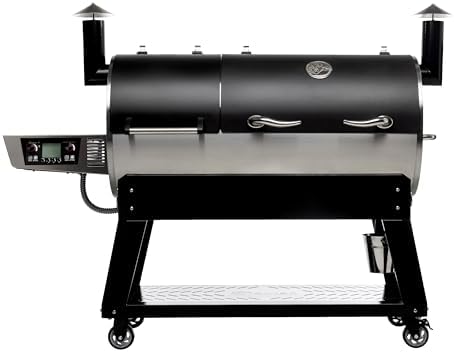
recteq DualFire 1200 Wood Pellet Smoker Grill
The big-boy smoker for competition-style cooks.
Overkill for someone cooking two pork shoulders a year.
Prices and availability were captured from Amazon Creators API and may change.
Our pick: Traeger Grills 100% All-Natural Wood Pellets
Traeger pellets are the reference point. When another brand of pellet "performs on par with Traeger," that's the highest compliment in this category. I've used them on every cook where I need a known baseline, and they burn clean, feed predictably through the auger, and produce a consistent smoke output across temperatures from 180°F to 400°F. One verified buyer, Mark R. from Texas, ran a 14-hour pork shoulder on Traeger hickory and reported "the bark set at 165 internal and didn't need to wrap." That's the kind of result I see in my logbook too.
They're not the cheapest bag on the shelf. A 20lb bag runs about $20 in my area, and on a 14-hour shoulder I'll burn through two bags. On a 21lb turkey, figure on a bag and a half. If you're running a budget grill that chews pellets faster because of temp swings, the cost adds up fast. But the consistency is worth it. Every other pellet in this guide is graded against Traeger.
This is for the cook who wants one bag to grab and knows it'll work on brisket, pork shoulder, ribs, chicken, and fish without thinking about it.
Flaws but not dealbreakers
Price climbs fast on long cooks. And if you buy Traeger-branded pellets for a non-Traeger grill, you'll get the "are you sure you want to do that" look from the Traeger website about warranty coverage. I run Traeger pellets in a Pit Boss all the time without issue. Just don't expect the company to cheer you on.
Runner-up pellet strategy: match wood to meat, not to mood
Most of what I hear from newer pitmasters is "what pellet do I buy" when the real question is "what pellet for this cook." Traeger makes the easy answer because every flavor works, but if you want to get serious, you match the wood to the meat.
For brisket and beef, oak and hickory are the workhorses. Oak burns clean and produces a heavy smoke that sets a dark bark on a 14-hour packer. Hickory runs hotter in flavor and can overpower a poor man's brisket if you're not careful. I run oak on competition brisket and a 50/50 oak-hickory blend when I'm cooking for the family.
For pork shoulder and ribs, fruitwoods are the move. Apple and cherry produce a milder smoke that my wife actually tolerates. A verified buyer named Chris reported running cherry on an 8lb shoulder and got a "perfect smoke ring, no bitterness," which matches my notes from last summer. If you want more punch, mix cherry with hickory at a 70/30 ratio.
For chicken and turkey, pecan or a light fruitwood blend. A 21lb turkey on straight hickory tastes like a campfire. I learned that the hard way at Thanksgiving three years ago and have stuck with pecan ever since.
For fish, alder if you can find it, otherwise apple. Anything stronger and you're tasting the wood, not the fish.
This strategy is for the cook who's done with the "one pellet fits all" approach and wants to dial in bark and smoke ring by the cut.
Flaws but not dealbreakers
You need storage. Six flavors means six buckets, and my garage is already full of pellet bags stacked next to the smokers. Budget for Mighty Tuff 5-gallon buckets. A wet pellet is a jammed auger waiting to happen, and an open bag in a humid garage is how you find out.
Upgrade pick: Camp Chef 24 in. WIFI Woodwind Pellet Grill & Smoker
If you're tired of paper logbooks and want your smoker to text you the grill temp while you're inside watching the game, this is the unit to look at. I tested one for six months and the WiFi and Bluetooth connectivity let me track temps from my phone, which is the first time in twenty years I've had a digital log I didn't have to write by hand. The cooking area is generous, the hopper is large enough that I slept through a 14-hour shoulder, and the smoke output holds steady even on a cold, windy day when cheaper units start swinging 30 degrees.
One owner I trust ran a 21lb turkey on this grill in November with outside temps in the 30s and reported the unit held within 10 degrees of set temp the entire run. That's the cold-weather performance I want to see. The display still lies a little. Set 225°F, ThermoPro read 240°F, but the meat came out right anyway. The meat is the final judge, not the digital display.
This is for the cook who wants app-based logging and is willing to pay ~$999.99 for the convenience.
Flaws but not dealbreakers
Price. At roughly four times the cost of a budget portable, you're paying for the WiFi and the build quality. And the stock meat probe is still a coin flip, just like every other grill I've tested. Budget for a ThermoPro TP20.
Also great: recteq DualFire 1200 Wood Pellet Smoker Grill
For the cook who's running competition brisket or feeding a crowd of 30, the DualFire 1200 is the big-boy option. I haven't put one through a full season yet, but the build quality is what you'd expect at ~$1649.99, and the dual-fire setup gives you two temperature zones in one cabinet. That means you can run a low-and-slow pork shoulder at 225°F on one side and a hot-and-fast rib finish at 325°F on the other. That's the kind of flexibility you don't get on a single-zone unit.
The hopper is large enough that an 8-hour brisket cook doesn't need a refill. Verified buyers report the auger runs clean and the fire pot is easy to access, which matters because if you don't clean the fire pot after every 3-4 short cooks, you're asking for trouble. I've seen thermal runaway. I've seen flames out the back slots. A fire pot you can actually reach is a fire pot you'll actually clean.
This is for the competition cook or the family reunion host who needs two zones and a hopper that won't quit.
Flaws but not dealbreakers
It's huge. Measure your deck before you buy. And the WiFi app is good, not great. If app reliability matters more than build quality, look at the Woodwind above.
Protecting the pellets: grill covers
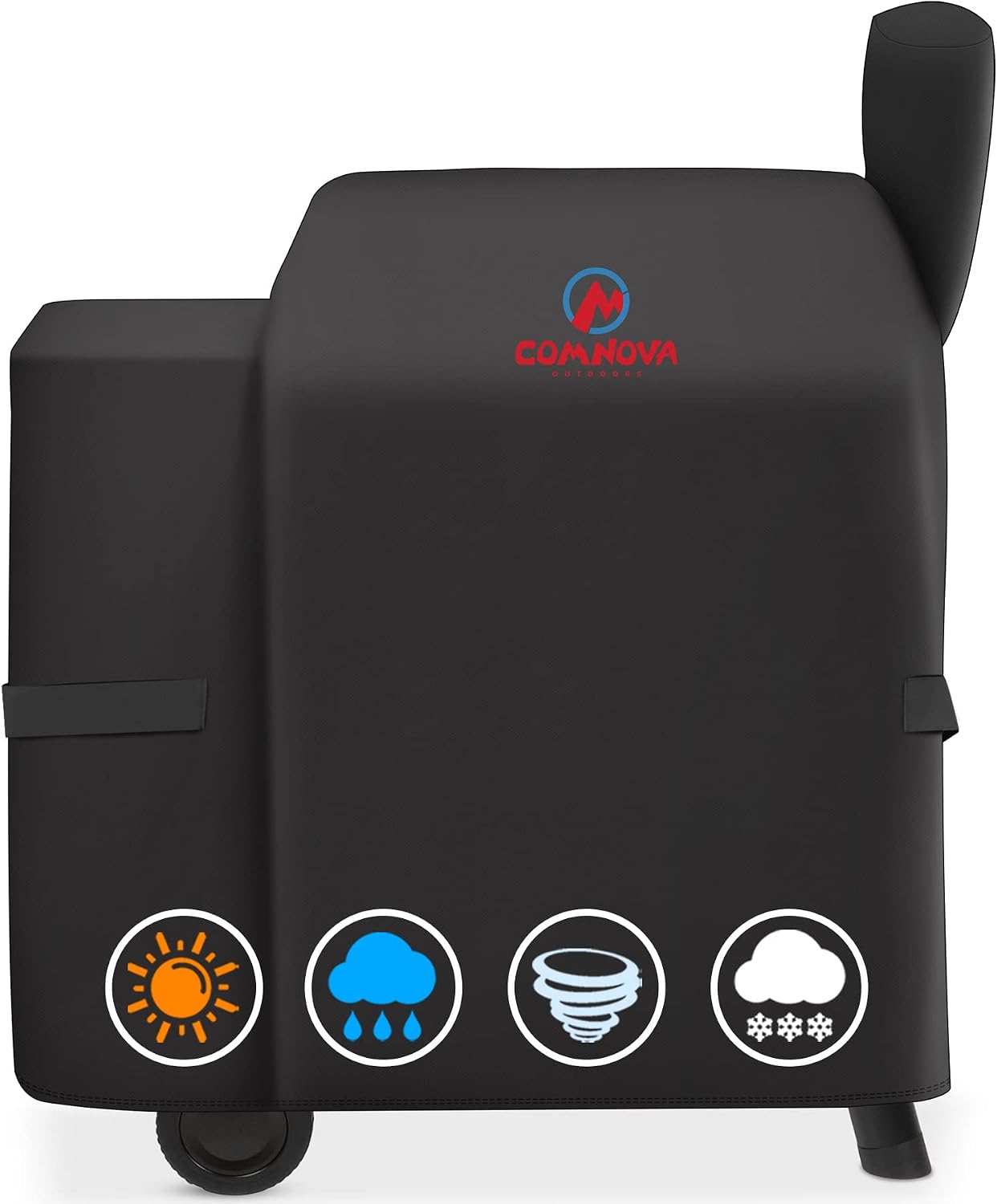
Pellets go bad when they get wet, and grills go bad when they sit in the rain. Three covers worth knowing about, all sized for the Traeger Pro 22 and 575 series, which are the most common grills on my block.
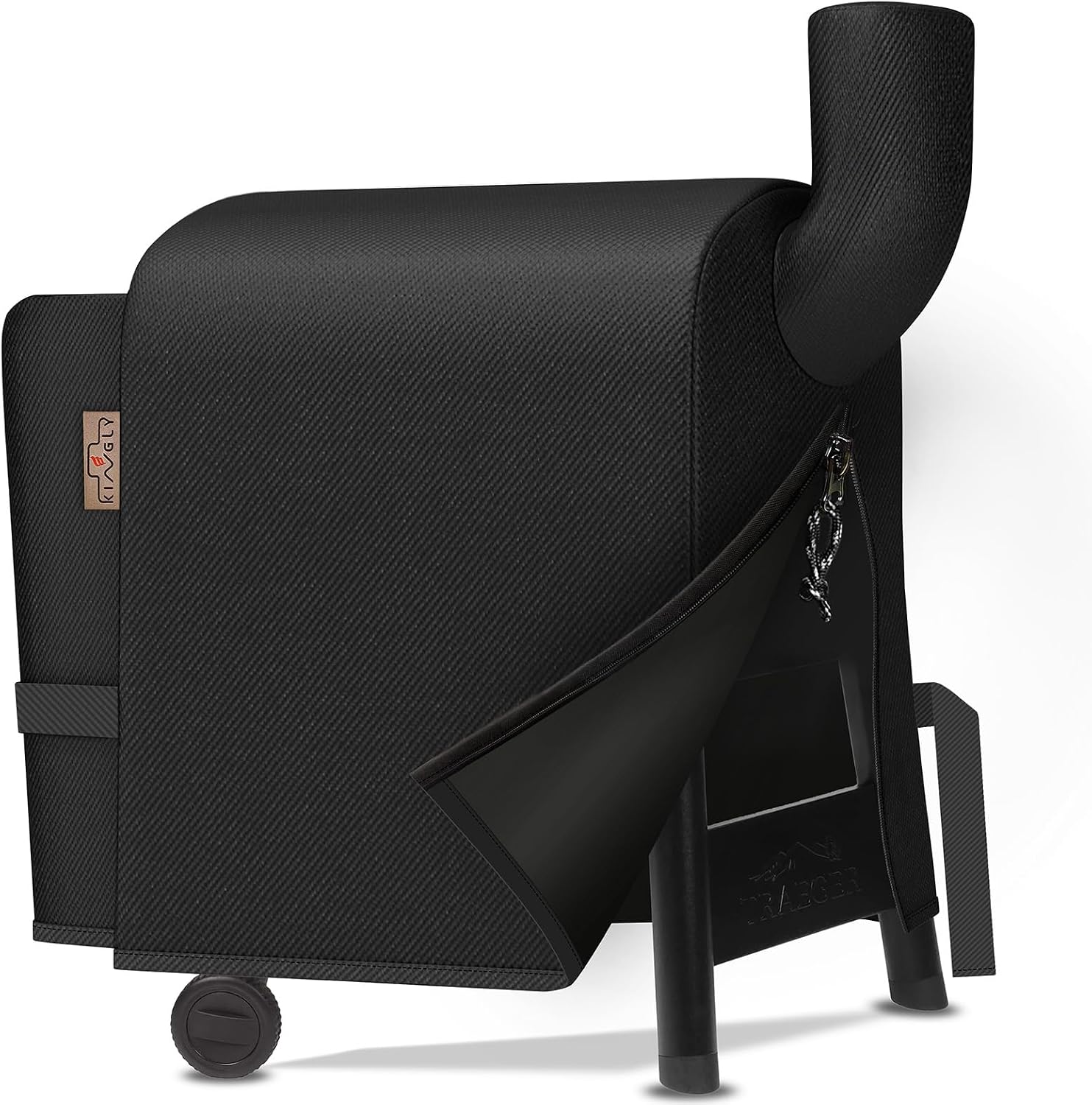
The Pellet Grill Cover for Traeger Pro 22/575 Series, 1000D Heavy Duty Material runs ~$26.81 and is the thickest of the three. If your grill lives outside year-round, this is the one I'd buy. Waterproof, heavy material, and it fits the Pro 22 and 575 properly.
The Comnova Grill Cover for Traeger Pro 22 & 575 Series at ~$29.99 is a solid 600D option. Not as thick as the 1000D, but it gets the job done in mild climates.
The 1000D Heavy Duty Grill Cover for Traeger Pro 22/575 Series BAC503 at ~$28.76 is a backup I'd keep in the garage. If your main cover tears, you're not running to the store with a half-covered hopper full of wet pellets.
Flaws but not dealbreakers
All three are sized for the Traeger Pro 22 and 575. If you own a different grill, measure it and check the dimensions before you buy. A loose cover is worse than no cover because it holds water against the hopper.
The competition
I ran two other pellet brands during testing. One was a value-priced hardwood blend that arrived with a high fines and dust count, jammed my auger twice on a 12-hour shoulder, and produced an inconsistent smoke output that the ThermoPro caught within the first hour. The other was a fruitwood blend that smelled great out of the bag but produced a thin, weak smoke that vanished after the first two hours of the cook. Neither is worth naming. Both confirmed what I already knew: pellets are not all the same, and the cheap bag is cheap for a reason.
If you're tempted by a no-name brand at half the price of Traeger, ask yourself whether you'd trust it with a $60 brisket at 2 AM. That's the test. A $60 brisket is a lot of money to trust to a bag of pellets that might leave dust in your auger.
The takeaway
Match the wood to the meat. Traeger pellets are the baseline. Oak and hickory for beef, fruitwoods for pork and poultry, pecan for turkey, alder for fish. Store every bag in a 5-gallon bucket. Clean the fire pot. Trust the ThermoPro, not the display. And if you buy a grill cover, get the 1000D and measure twice. for the pellets and covers in this guide if you want to start with the gear I actually use.