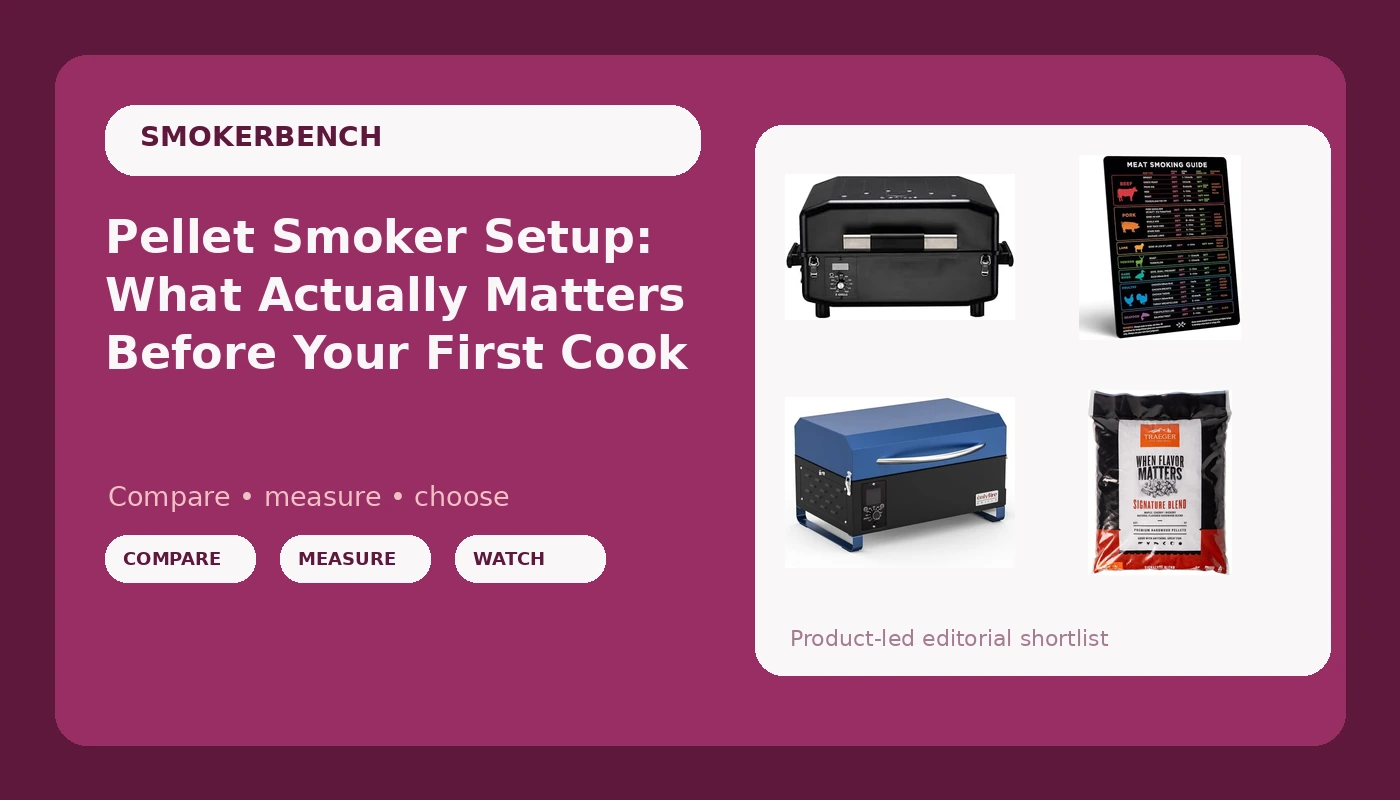
A pellet smoker setup is a chain, not a single purchase. The controller decides how much fuel the auger drops, the firepot decides how cleanly that fuel burns, the pellets decide how much dust and ash you fight, and your temperature reference decides whether you pull the meat at the right moment or twenty degrees late. Buy a decent grill and load it with damp pellets and you will still spend the night watching a graph flatten out. Buy great pellets and ignore the controller and you will still be fighting an auger jam at hour six.
Most shoppers start with the grill and stop there. This explainer covers four pieces of a working setup: a compact pellet grill for small spaces, a full size alternative, a bag of all natural wood pellets, and a magnetic temperature chart. No price claims and no invented test numbers. Just what each item is, who it fits, and what to verify before you commit a packer brisket to it.
Related: How Temperature Stability Separates Pellet Grills →
Quick answer
A pellet smoker setup works when three things line up: a controller that holds a steady set temperature, dry fuel that feeds without jamming, and a reliable way to check internal temperature without opening the lid. For a small patio, balcony, or truck bed, the Z GRILLS 200A covers the grill side. For a larger footprint, the ONLYFIRE GS313 is the alternative to compare against it. Traeger Signature Blend pellets feed either one, and the meat temperature magnet gives you target temps at a glance. Match the grill to your space first, then buy fuel and a temperature reference you trust.
Four useful options
| Model | Best fit | What stands out |
|---|---|---|
| Z GRILLS 2026 200A Pellet Grill & Smoker | Small spaces, camping, and first pellet grill | 202 square inch cooking area, PID 3.0 precision control, auto feed system, portable build |
| ONLYFIRE GRILLS BBQ Wood Pellet Grill Smoker, Blue GS313 | Cooks who want a full size pellet rig | Pellet grill and smoker configuration in blue; verify cooking area, hopper, and controller on the listing |
| Traeger Grills Signature Blend Wood Pellets, 18 lb. Bag | Fuel for any pellet grill or smoker | Signature Blend, all natural wood, 18 lb bag for smoking, grilling, baking, and roasting |
| Meat Temperature & BBQ Smoker Guide Magnet | Anyone still guessing at doneness | Wood, time, and temperature chart in a magnetic format that sticks where you cook |
The compact pick: Z GRILLS 2026 200A Pellet Grill & Smoker
The trade off is capacity, and it is not a small one. A 202 square inch grate fills up fast once you add a water pan or a probe cable, and a bigger cook means either two sessions or a different grill. What you get in return is a unit that stores easily, moves without a second person, and runs on a controller type that is generally steadier than a simple dial. If you cook for two to four people and you have been putting off a pellet grill because everything else looks like patio furniture, this is the size class to start in. Confirm the grate dimensions and the hopper capacity on the current listing before you order, because compact models change between model years.
The full size alternative: ONLYFIRE GRILLS GS313
Before you commit to any grill in this size class, read the listing for four things: cooking area in square inches, hopper capacity, whether the controller is a PID or a simpler timed feed, and how the firepot is built. Those four specs decide hold time, and hold time is what separates a smoker you can sleep through from one that wakes you up at 2 AM. Steel thickness at the firepot is the classic place manufacturers save money, and thin steel warps, which changes airflow and turns a steady cook into a chasing game. None of that is visible in a product photo, so the spec sheet and the questions in the listing are where you do the work.
The fuel: Traeger Grills Signature Blend Wood Pellets
Pellets are the most overlooked part of a pellet smoker setup, and they cause more bad cooks than bad controllers do. Dust and broken pellets settle at the bottom of the hopper, and that dust is what compacts and stalls an auger partway through a long cook. Whatever brand you buy, store the bag sealed and off a concrete floor, and if you pour the last of a bag into the hopper, screen out the fines first. Switching pellet brands mid cook also changes your temperature behavior, because burn characteristics and moisture content differ from one manufacturer to the next. Pick a blend, learn it, and keep the hopper topped up so the auger is never pulling from an empty spot.
The reference: Meat Temperature & BBQ Smoker Guide Magnet
Treat any printed chart as a starting reference, not a verdict. Published target temperatures for pork, poultry, and beef vary by source and by preference, and your own probe is the final word on what the meat is doing. The value of a magnet like this is speed: you glance, you get a number, you go back to the cook instead of standing in the kitchen searching. Pair it with a probe you trust and use the chart to sanity check the probe rather than the other way around.
Prices and availability may change. Product images, names, and retailer links must be matched by verified ASIN. Do not state a current price, rating, stock status, or measured result without current evidence.
What actually holds a pellet grill at temperature
A pellet grill is a feedback loop. A temperature sensor reads the cook chamber, the controller compares that reading to your set point, and the controller tells the auger how long to run so the firepot gets more or less fuel. Everything else is supporting hardware. When the loop is tight, the temperature graph is a nearly flat line and you can sleep. When the loop is loose, you get swings, and a swing of thirty degrees is the difference between a clean cook and a fire that is either starving or running hot.
Three things loosen that loop. The first is controller type: a PID controller adjusts feed rate continuously, while a simpler timed feed runs on a fixed cycle and reacts more slowly to a door opening or a cold front. The second is the firepot and the airflow around it, since thin steel warps, warped steel changes the air path, and a changed air path changes how completely the pellets burn. The third is weather. Wind pulls heat off the chamber faster than the controller can compensate for it, which is why a grill that behaves perfectly in July can look broken in a Kansas February. If you cook in wind, build a barrier or accept a wider graph.
None of this is visible in a spec sheet headline. The controller type usually is listed. Firepot construction often is not, which is why the questions other buyers ask in a listing are worth reading before you buy.
Why pellets and target temps decide the outcome
Pellet quality affects two separate things: flavor and reliability. On flavor, the wood species in the blend is what you are actually tasting, and the smoke ring that everyone photographs is mostly a cosmetic reaction near the surface rather than proof of a good cook. Chase the cook, not the color. On reliability, moisture is the enemy. Pellets that have absorbed humidity crumble into dust in the hopper, dust compacts at the auger, and an auger jam at hour six of a brisket is the most expensive kind of failure because you cannot fix it without losing your cook.
Target internal temperature is the other half. Time estimates on any chart assume a specific chamber temperature, a specific piece of meat, and no wind. Your cook has all three of those variables and they never match the chart exactly. The reliable method is to hold chamber temperature steady, watch internal temperature, and use time only for planning when to start.
- Measure your cooking space and pick a grill footprint that fits it, whether that is a compact 202 square inch unit or a full size rig.
- Read the listing for controller type, cooking area, hopper capacity, and firepot construction before you buy anything.
- Buy one pellet blend, store it sealed and dry, and screen the fines before they reach the hopper.
- Log your first few cooks: set temperature, actual chamber temperature, outside conditions, and when you wrapped or pulled.
- Cook to internal temperature with a probe you trust, using a printed chart only as a reference point.
Practical guidance for a setup that holds
- Keep the hopper at least half full on long cooks so the auger never pulls from an empty pocket.
- Store pellets indoors, off concrete, with the bag sealed, and never pour the dusty bottom of a bag straight into the hopper.
- Screen or sift fines out of older pellets before a brisket cook, since that is where jams start.
- Check that the hopper lid seals against rain, because a damp hopper is a slow moving failure you will not notice until hour five.
- Build a wind break for the cook chamber if you smoke in an exposed spot, and expect a wider temperature graph when you do not.
- Test the whole setup on a cheap cook first, like chicken or a pork butt, before you trust it with an expensive packer brisket overnight.
- Do not treat any grill as set and forget. Check the graph, check the hopper, and check the probe.
Which option should you choose?
Choose the Z GRILLS 2026 200A Pellet Grill & Smoker when space, portability, and a compact cooking area matter more than capacity, and when you want a PID controller in a small package. Choose the ONLYFIRE GRILLS BBQ Wood Pellet Grill Smoker, Blue GS313 when you want a full size pellet grill and smoker and are willing to verify the specs that determine hold time before you buy. Choose the Traeger Grills Signature Blend 100% All-Natural Wood Pellets when you need fuel for either grill and want a consistent blend in a bag size you can finish. Choose the Meat Temperature & BBQ Smoker Guide Magnet when you want target temperatures and timing visible at the grill instead of buried in a phone.
The limitation worth naming: a chart, a bag of pellets, and a compact grill do not make a competition setup, and nothing here replaces a temperature log from your own first cook. Specs listed by a manufacturer can also change between model years, so verify current details on the product page before ordering. Capacity in particular is the spec people regret ignoring.
The bottom line
A pellet smoker setup succeeds or fails on temperature stability, and temperature stability comes from a controller that reacts quickly, a firepot that is not warped, dry fuel that feeds cleanly, and a cook who knows the target internal temperature instead of guessing. Start with the grill that fits your actual cooking space, feed it one pellet blend you have learned, keep the hopper dry, and log your first cooks so you know what your rig does at 2 AM. Everything else, including the apps and the accessories, is garnish.