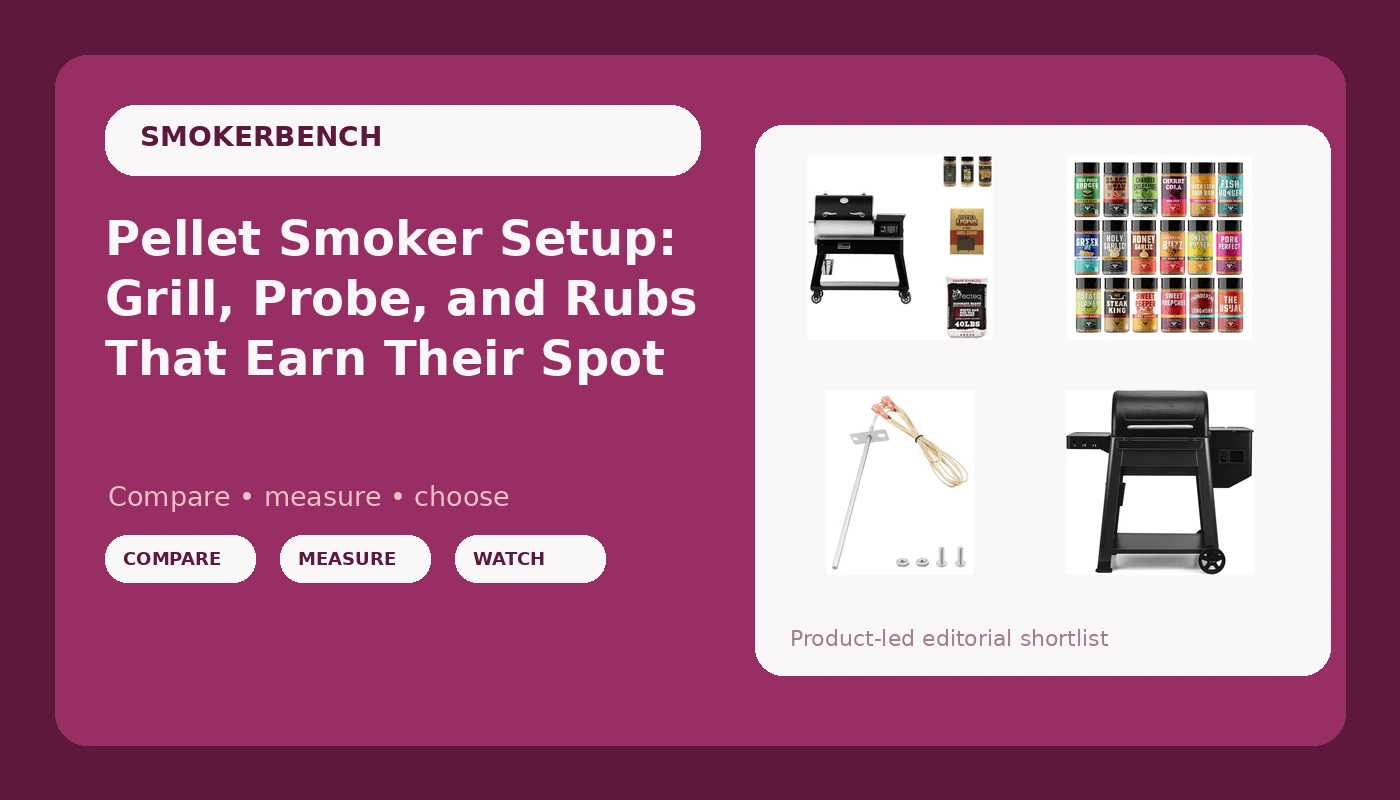
A pellet smoker setup gets discussed like it is one purchase. You pick a grill, you pay for it, you cook. Then the first overnight brisket happens and the real list shows up: the controller reading that stopped matching reality somewhere around hour five, the rub you ran out of at hour four, the second thermometer you bought because you stopped believing the first one. The cooker is the center of a pellet smoker setup, but it is not the whole thing, and the parts around it are the ones that decide whether a long cook goes smoothly or turns into a night of standing in the yard with a flashlight.
This is an explainer on the four pieces worth thinking about before you spend money: the grill itself, the temperature sensor that feeds the controller its numbers, and the seasoning you will burn through faster than you expect. It is written for someone who wants to understand what each piece does and when it is worth buying, not for someone who wants a spec sheet read out loud. There is no testing log behind this article, so nothing here is presented as a measured result. What follows is what the listings state, what the parts do, and how to decide which one you actually need first.
Related: How Pellet Grill Temperature Swings Actually Work →
Quick answer
Buy the grill first, and buy it on cooking area and the stated temperature range, because those two specs decide whether it fits the cooks you actually do. Add a spare temperature sensor and a seasoning set afterward. WiFi and app connectivity are conveniences layered on top of a cooker that either holds temperature or does not. If you already own a Rec Tec or recteq model named in the probe listing and your chamber readings have gone strange, the sensor is the cheapest part to replace and the first one to suspect.
Four useful options
| Model | Best fit | What stands out |
|---|---|---|
| recteq Patio Legend 600 Pellet Smoker | One cooker that spans low-and-slow and high heat | Stated 180°F to 700+°F range, WiFi and app connectivity, sold with a grilling basics bundle |
| Traeger Westwood Wood Pellet Grill & Smoker | A first pellet grill in a household that wants a familiar ecosystem | 653 square inches of stated cooking area and WiFi connectivity |
| 7" Large RTD Probe Temperature Sensor | Replacing a chamber sensor on the listed Rec Tec and recteq models | 7 inch probe length with fitment listed for specific grill models |
| Fire & Smoke Society Motherload (18-Pack) Variety | Stocking a rub shelf without buying full-size jars of each blend | 18-pack variety of BBQ rubs and seasonings |
The main rig: recteq Patio Legend 600 Pellet Smoker
The trade-off with a wide range is that a single cooker has to behave at both ends of it. Smoking at 225°F and searing at 700°F are different jobs for the same firepot, and a grill that advertises both is asking you to trust one controller to do two very different things well. That is not a reason to avoid it. It is a reason to pay attention to your first few cooks and to keep a way of verifying chamber temperature that does not depend on the same sensor the controller is reading.
The mainstream alternative: Traeger Westwood Wood Pellet Grill & Smoker
Cooking area is the spec people underestimate most. Six hundred and fifty three square inches sounds like a lot until a full packer brisket is lying on the grate and you realize you also wanted room for a pork butt and a pan of beans. Measure your biggest cook in grate space before you commit, and remember that a smaller grate is not a dealbreaker if you rarely cook for a crowd. It just means you plan your cooks in sequence instead of all at once.
The spare part: 7" Large RTD Probe Temperature Sensor
This is the least exciting item on the list and the one most likely to save a cook. Chamber sensors live in heat and smoke and grease, and they do not last forever. When the display starts telling you a story you do not believe, the sensor is the cheaper of the two suspects to rule out, and having one on the shelf means a bad reading does not end your day. Check the fitment list against your model before ordering, because these parts are model-specific by design.
The seasoning: Fire & Smoke Society Motherload (18-Pack) Variety
Rubs are the piece of a pellet smoker setup that people treat as an afterthought and then rebuy constantly. The honest math is simple: count how many distinct profiles you actually use in a season. If the answer is two, a large container of each beats a variety box. If the answer is six or you are still exploring, a variety pack stops you from owning four nearly identical jars of the same sweet-and-smoky blend.
Prices and availability may change. Product images, names, and retailer links must be matched by verified ASIN. Do not state a current price, rating, stock status, or measured result without current evidence.
What a pellet grill is actually doing while you sleep
A pellet grill is a small automated fire. An auger pulls pellets from the hopper into a firepot, a fan feeds that fire air, and a controller decides how often the auger runs based on what the temperature sensor is reporting. Every one of those decisions depends on the sensor being right. If the probe reads high, the controller starves the fire and your cook stalls. If it reads low, the controller overfeeds and you get temperature spikes. Either way, the food pays for it.
That is why chamber temperature sensors matter more than most buyers expect. An RTD sensor changes electrical resistance as it heats, and the controller converts that resistance into the number on the display. It is a simple system, and it is only as good as the probe feeding it. Food probes, the ones you push into a brisket, are a separate part doing a separate job. The chamber probe tells the grill how hot to run. The food probe tells you when dinner is done. Confusing the two is one of the most common mistakes in a first year of pellet cooking.
There is also a difference between what an app shows and what a grill does. WiFi connectivity gives you the same number on a phone that you would see on the controller, which is genuinely useful at 2 AM when you would rather not walk outside. It does not change how the grill holds temperature. An app that loses its connection does not lose the cook, but it does mean you should still know how to read the grill itself.
Reading a pellet grill listing without getting fooled
Three numbers carry most of the weight in a pellet grill listing: cooking area, temperature range, and what is included. Cooking area, stated in square inches, tells you how much food fits at once. Temperature range tells you what kinds of cooks the grill is built for, and a stated low end around 180°F is what you want for jerky and long holds, while a high end in the searing range opens up quick cooks. What is included matters because a bundle can quietly cover the first accessories you would otherwise buy separately.
Everything else in a listing is a feature, not a capability. WiFi is a feature. A grilling basics bundle is a feature. Neither one makes food better on its own, and neither one compensates for a grill that cannot hold a steady temperature. Read the three numbers first, then read the features, and decide whether the extras are things you would have bought anyway.
- Write down the biggest cook you realistically do in a year, not the one you imagine hosting.
- Convert that cook into grate space. A full packer brisket takes up a large share of a small grate.
- Check that the stated temperature range covers both your usual smoke temperature and any high-heat cooking you want.
- Decide how you will verify chamber temperature, and price a spare sensor into the purchase.
- Count the rubs you actually use in a season before buying a variety pack or a large container.
What to do in the first month
- Log the controller reading against a second thermometer on your first long cook, and note where they disagree.
- Keep the chamber probe clean, since baked-on residue sits between the sensor and the air it is measuring.
- Store rubs sealed, dry, and out of direct sun, because clumped rub is a seasoning problem, not a grill problem.
- Keep a spare sensor on the shelf so a bad reading does not end a cook day.
- Buy pellets you can restock locally or reliably online, because a blend you cannot re-buy mid-season forces a change you did not choose.
Which option should you choose?
Choose the recteq Patio Legend 600 Pellet Smoker when you want one cooker that spans low-and-slow smoking and high-heat searing, with WiFi and app connectivity and a grilling basics bundle included. Choose the Traeger Westwood Wood Pellet Grill & Smoker when 653 square inches of stated cooking area fits your cooks and you would rather stay inside a large, familiar pellet grill ecosystem. Choose the 7" Large RTD Probe Temperature Sensor when you already own one of the listed Rec Tec or recteq models and need a replacement chamber sensor rather than a new grill. Choose the Fire & Smoke Society Motherload (18-Pack) Variety when you want several rub profiles on hand without buying full-size containers of each.
One caveat worth stating plainly: every specification above comes from the product listings, not from a cook log. The probe's fitment applies to the models named in its listing, and no grill here has been measured against another on temperature stability. If you are choosing between the two grills, treat the stated cooking area and temperature range as the deciding facts and let the extras break the tie.
The bottom line
A pellet smoker setup works best when you buy it in the right order. Start with the grill, judge it on cooking area and stated temperature range, and treat WiFi as a convenience rather than a reason to buy. Then add the two things that quietly decide how a long cook goes: a chamber sensor you can swap when readings stop making sense, and a seasoning lineup sized to how you actually cook. Get those three decisions right and the overnight brisket stops being an act of faith.