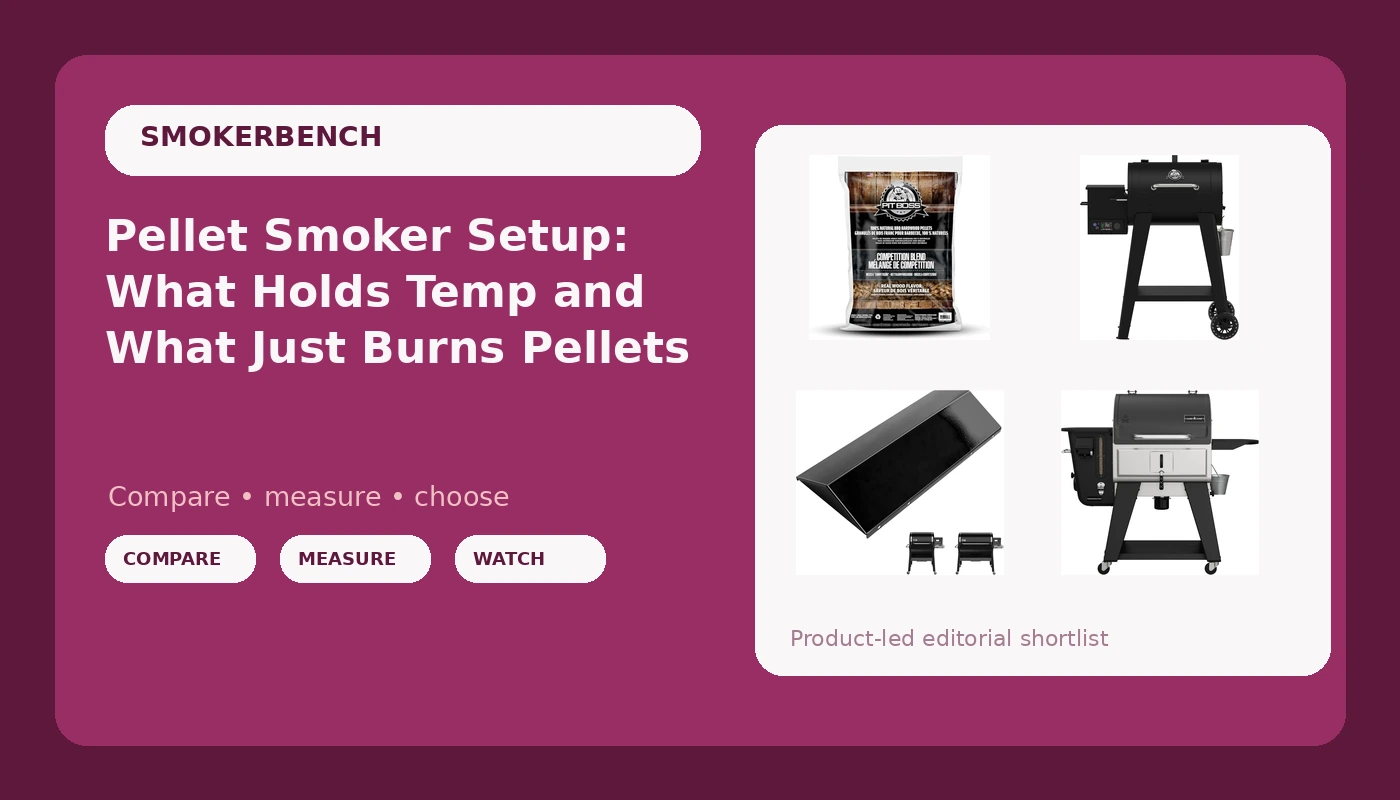
Most shoppers building a pellet smoker setup spend their research time comparing hopper lids and app screenshots. The number that actually decides whether dinner lands at 6 PM or at midnight is hold time, meaning how long the grill sits at your set temperature without anyone touching it. A pellet smoker setup comes down to four jobs: the controller and temperature range on the grill, the fuel you burn, the hopper that feeds the firepot, and the parts that take direct heat and eventually wear out. The four items below cover all four jobs, from a WiFi-equipped 24-inch Camp Chef to a 20-pound bag of Pit Boss competition blend pellets and a replacement flavorizer bar for the Weber SmokeFire.
Related: Why Your Pellet Grill Swings 30 Degrees in a Kansas Wind →
Quick answer
The spec that matters most is the temperature range and how the controller holds it, because a pellet grill is really a controller, an auger, and a firepot working as one system. After that, match hopper size to your typical cook length and buy fuel you can keep dry. On paper, the Pit Boss 500 FB2 is the most fully documented option here: 518 square inches of cooking space, a 180°F to 500°F range, a meat probe, and a 5-pound hopper. The Camp Chef Woodwind Pro WiFi 24 carries the least detail in its listing name, so read the full spec sheet before you commit. The pellets and the flavorizer bar are the upkeep side of the same setup.
Four useful options
| Model | Best fit | What stands out |
|---|---|---|
| Camp Chef Woodwind Pro WiFi 24 Pellet Grill | A WiFi-controlled 24-inch class rig | Woodwind Pro model with WiFi named in the listing |
| Pit Boss 500 FB2 Series Wood Pellet Grill & Smoker | A documented, budget-oriented starter rig | 518 sq. in. cooking space, 180°F to 500°F range, meat probe, 5 lb. hopper |
| Pit Boss Competition Blend Hardwood Pellets, 20 lbs. | Fuel for any pellet grill or smoker | All natural hardwood competition blend in a 20-pound bag |
| SafBbcue 68947 Flavorizer Bar | Replacing a worn bar on a Weber SmokeFire EX4 or EX6 | Fitment listed for both SmokeFire sizes |
The main rig: Camp Chef Woodwind Pro WiFi 24 Pellet Grill
Here is the honest trade-off with a WiFi grill: the app is a convenience, not a feature. What I care about is whether the controller can hold a set temperature through a 12-hour cook while the outside temperature drops and the wind picks up, and no listing title tells you that. What a listing title does tell you is the size class, the controller type, and the brand's positioning, which is why the Woodwind Pro is worth a look and also why you should open the full spec sheet and confirm hopper capacity, temperature range, and what accessories ship in the box. Buy this one when you want the WiFi controller and the larger 24-inch class footprint, and you accept that the published detail is thinner than the value option below.
The value rig: Pit Boss 500 FB2 Series Wood Pellet Grill & Smoker
The 5-pound hopper is the trade-off, and it is a real one. A 5-pound hopper is a short leash on a long cook. At smoking temperatures you will be checking and refilling more often than you would on a rig with a bigger hopper, which matters most when you are trying to sleep through the stall on a brisket. The flip side is that this is a documented grill with a wide 180°F to 500°F range, a meat probe, and a flame broiler for searing, all of which make it a reasonable first pellet grill or a second rig for weeknight cooks. Buy it for the published specs and the searing capability, and plan your fuel around the hopper size rather than pretending it is bigger than it is.
The fuel: Pit Boss 100% All Natural BBQ Hardwood Pellets, Competition Blend
Pellet quality shows up in two places: the smoke flavor in the meat and the dust in the bottom of the hopper. Fine dust is what feeds an auger jam, and humidity is what creates the dust. A 20-pound bag gives you enough fuel to run several cooks and to notice whether a blend is burning clean in your particular firepot, which is information no product page can give you. Buy the bag when you want a neutral, all-purpose fuel for a pellet grill or smoker and you are willing to store it sealed and dry.
The wear part: SafBbcue 68947 Flavorizer Bar for Weber SmokeFire EX4 EX6 Wood Pellet Grill
Wear parts are the least glamorous purchase in a pellet smoker setup and the one that keeps a grill usable. A warped bar changes how heat reaches the grate, and a bar that no longer fits lets grease fall straight into the firepot. Buy this when you own a SmokeFire EX4 or EX6 and the original bar has seen better days, and confirm the fitment against your exact model before ordering, because a bar that fits one SmokeFire size is not automatically right for the other.
Prices and availability may change. Product images, names, and retailer links must be matched by verified product code. Do not state a current price, rating, stock status, or measured result without current evidence.
Why hold time beats every other spec
A pellet grill does not have a thermostat in the way your oven does. It has a controller that decides how often to run an auger, an auger that drops pellets into a firepot, and a fan that feeds that fire oxygen. The controller reads a temperature sensor inside the cook chamber, compares that reading to your set point, and adjusts the feed rate. Everything about how the grill performs for a brisket flows from that loop.
This is why temperature range is the first number to read and the last number to trust. A listed 180°F to 500°F range tells you the controller is designed to run in both a low smoking band and a high grilling band. It does not tell you how tightly the grill holds 225°F on a cold night, how much the temperature recovers after you open the lid to spritz, or whether the swing widens as the hopper empties. Those are the questions a temperature log answers, and no product listing includes one.
Practically, that means you should evaluate a grill by three things you can verify before buying. First, the published temperature range and controller type, because a digital controller with a probe gives you more to work with than a dial with no feedback. Second, the hopper size relative to your longest cook, because a small hopper converts a relaxing overnight smoke into a series of alarms. Third, the parts around the firepot, because thin steel and cheap bars are what fail first.
Then judge the extras honestly. WiFi is a convenience. A meat probe is useful if you trust it and verify it. A flame broiler adds a direct grilling zone, which turns one machine into two. None of those replace a stable controller, and none of them fix a hopper that runs dry at hour six.
What a competition blend actually tells you
"Competition blend" is a marketing category, not a regulated standard. It generally means a mix of hardwoods rather than a single species, and the mix varies by brand. Some blends lean on oak or hickory for a heavier smoke profile, others on apple or cherry for something softer. Two bags with the same label can produce noticeably different smoke on the same grill.
What you can control is how the pellets behave in your machine. Pellet length and density affect how evenly the auger feeds. Moisture affects how cleanly they burn and how much dust they leave behind. Storage is therefore part of the fuel decision: a bag left open in a humid garage will produce soft pellets and a hopper full of fines, and fines are the leading cause of an auger jam in the middle of a long cook.
The practical approach is to buy a blend in a size that lets you run several cooks, keep it sealed between uses, and pay attention to the ash and dust you find in the firepot afterward. That tells you more about a pellet than any label claim about flavor. A 20-pound bag is a reasonable unit for that kind of evaluation because it is enough fuel to see a pattern and small enough that you are not stuck with a bad match for a year.
For the grill itself, the same logic applies in reverse. Buy the controller and the hopper you can live with, then let the pellets do the flavor work. If the grill cannot hold temperature, no blend will save the cook, and if the hopper is too small for your cooks, the best controller in the world just means you get to watch a good grill cool down while you fetch a bag.
How to decide, in order
- Set your longest realistic cook. If it is an overnight brisket, hopper size is a hard filter before anything else.
- Read the published temperature range and controller type, and treat a listing with no range as an unknown rather than an advantage.
- Decide whether you need direct grilling. A flame broiler changes what the machine can do on a weeknight.
- Decide whether WiFi control is worth paying for, remembering that it is convenience rather than cooking performance.
- Budget for fuel and wear parts alongside the grill, because pellets and flavorizer bars are recurring costs, not one-time purchases.
Practical guidance before you buy
- Measure your cooking area needs against 518 square inches to see whether a mid-size chamber fits your family and your parties.
- Plan on storing pellets sealed and off the concrete, since moisture is what turns good fuel into dust and dust is what jams an auger.
- Verify fitment on any replacement part against your exact model before ordering, especially across two sizes of the same grill line.
- Treat a meat probe as a starting point and confirm it against a known reading before you trust it on a $60 brisket.
- Read the full listing for a WiFi grill rather than the title, because hopper capacity, range, and included accessories are often buried below the fold.
Which option should you choose?
Choose the Camp Chef Woodwind Pro WiFi 24 Pellet Grill when you want a 24-inch class pellet grill with a WiFi controller named in the listing and you are prepared to verify the full spec sheet before buying. Choose the Pit Boss 500 FB2 Series Wood Pellet Grill & Smoker when you want published numbers to compare, a 180°F to 500°F range, a meat probe, and a flame broiler, and you can plan around a 5-pound hopper. Choose the Pit Boss 100% All Natural BBQ Hardwood Pellets, Competition Blend when you need 20 pounds of all-purpose fuel for a pellet grill or smoker. Choose the SafBbcue 68947 Flavorizer Bar when you own a Weber SmokeFire EX4 or EX6 and need to replace a worn bar.
One caveat that applies to all four: these are listing facts, not test results. Nobody in this article has logged a temperature graph for these specific units, and the ranges, capacities, and fitment claims come from the product listings. Confirm the current specs, the included accessories, and the fitment on the retailer page before you order, since manufacturers revise controllers, hoppers, and part numbers between production runs.
The bottom line
A pellet smoker setup is a system, and the system fails at its weakest point. The controller and temperature range set the ceiling on what the grill can do. The hopper decides whether you sleep. The pellets decide the smoke and the jam risk. The flavorizer bars decide whether grease ends up in the firepot. Spend your attention in that order, verify the specs on the listing rather than the title, and buy the fuel and wear parts with the same seriousness you bring to the grill, because a great rig with a dry hopper and a warped bar still cooks badly.