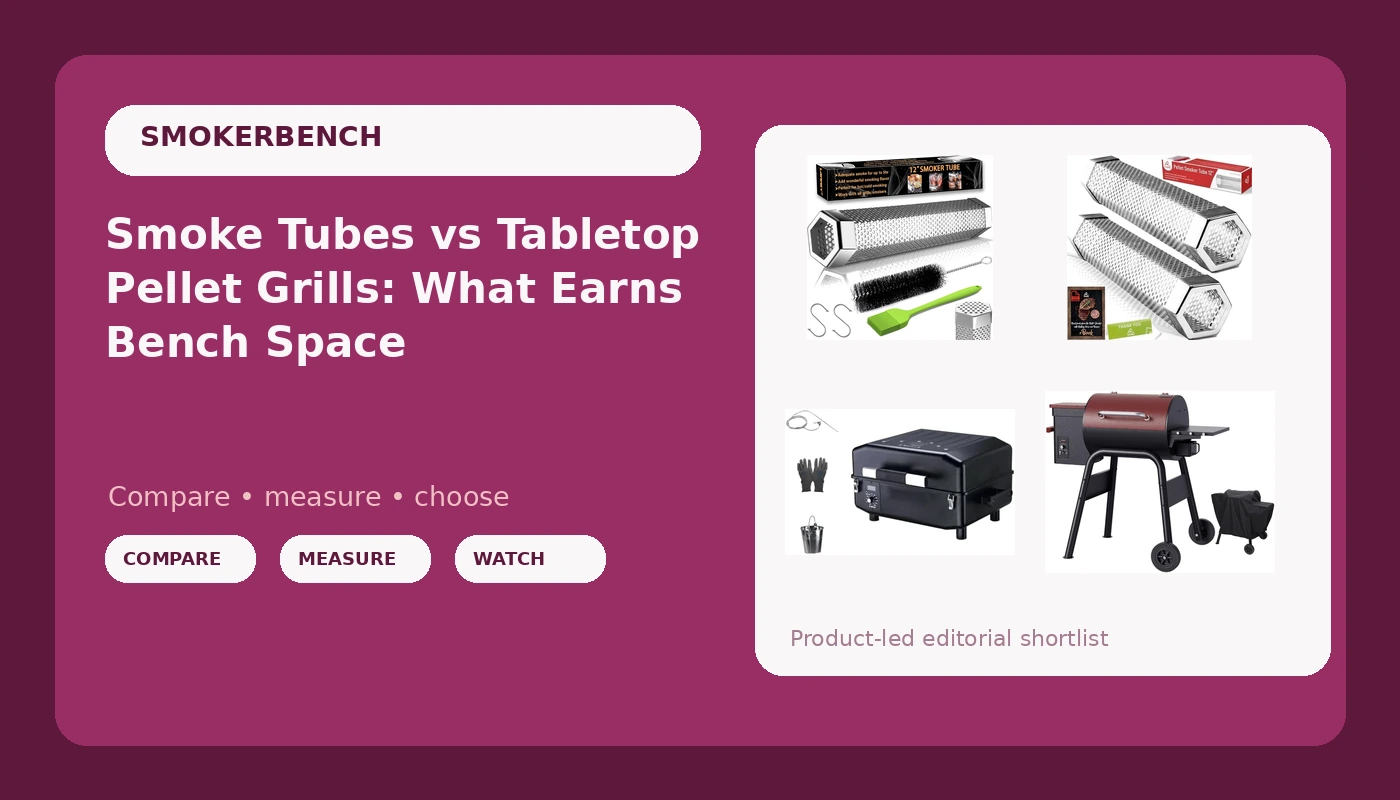
I have four pellet grills in the garage and a temperature logbook that goes back to my first cook, and the question I get from neighbors is almost never which rig to buy. It is how to get more smoke out of the rig already sitting on their patio. That is why this pellet smoker setup comparison exists, and it is also why the four products below do not all do the same job. Two of them are smoke tubes, which are the cheapest way to fix a grill that runs too clean. Two of them are tabletop pellet grills, which are the cheapest way to stop borrowing somebody else's rig on a Saturday morning.
I judge this category the way I judge everything else: by whether it holds temperature and by whether it still works at hour six. A smoke tube has no controller and no auger, so the test is simpler. Does it stay lit, does it make smoke long enough to matter, and does it survive being dropped on concrete. A tabletop pellet grill has to do everything a full size rig does, only in a footprint that fits on a patio table, and that is where most of them come up short.
If you already own a pellet grill, buy a smoke tube before you buy anything else. If you do not own a grill yet, the Z Grills tabletop is the one in this group I would trust with a real cook. That is the short answer. The long answer involves burn time, controller quality, published cook area, and the fact that a 12 inch tube and a 202 square inch grill are solving two completely different problems for two completely different cooks.
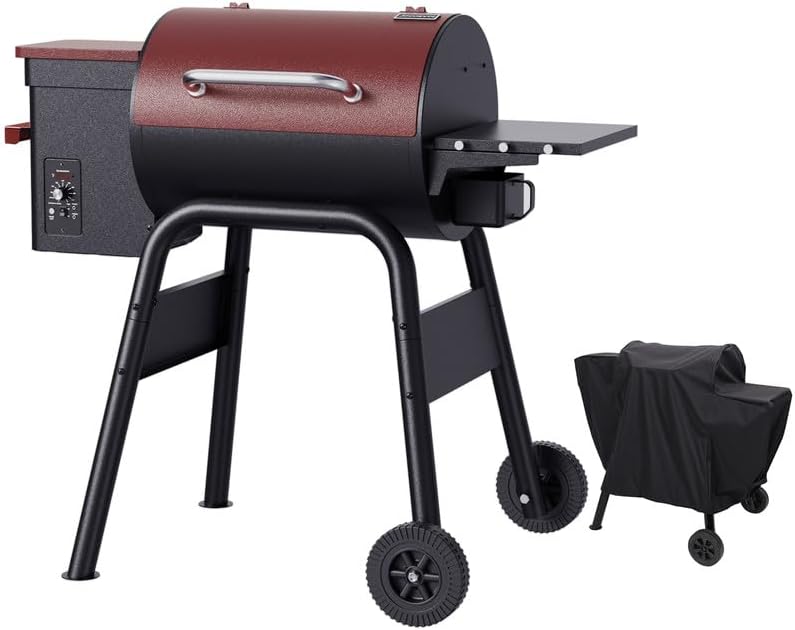
Jocoevol Wood Pellet Smoker Grill Electric Bbq Grills for Backyard Outdoor
The lowest entry point into an actual hopper fed pellet grill, electric feed, built for backyard use
The listing does not publish a cook area or a controller type, so you are trusting the box
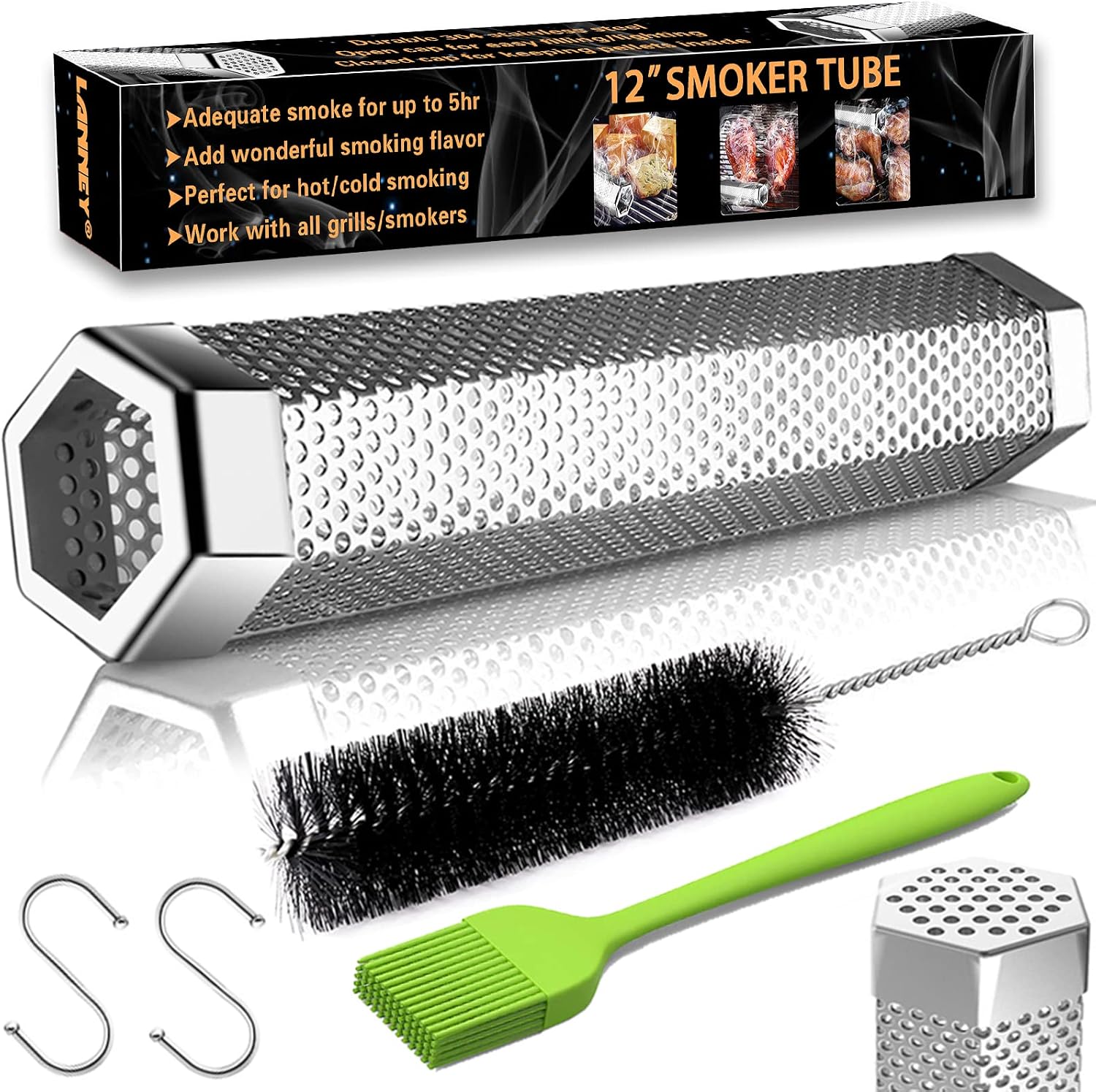
Smoke Tube for Pellet Smoker, 12'' Smoker Tube for Pellet Grill - Hot or Cold Smoker Accessories for Electric Gas Charcoal Grilling, Premium Stainless Steel Portable Barbecue Smoking Tube, Bonus Brush
Stainless steel, 12 inches, works in gas, electric, charcoal or pellet, and the brush is included
One tube only, and the listing does not publish a burn time
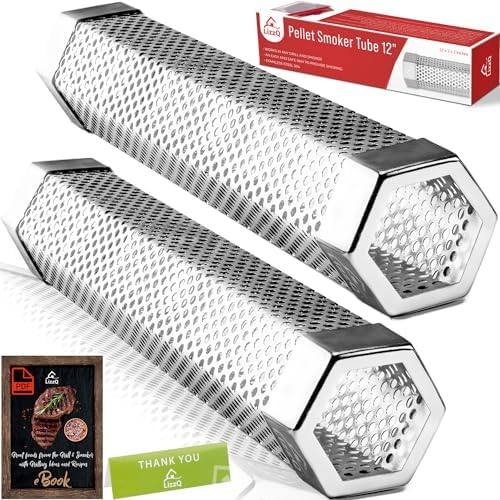
LIZZQ Premium Pellet Smoker Tube 12" (Set of 2) 5 Hours of Billowing Smoke
Two tubes in one box, and the listing claims five hours of billowing smoke per fill
You pay for a second tube you may never fill, and no brush is mentioned
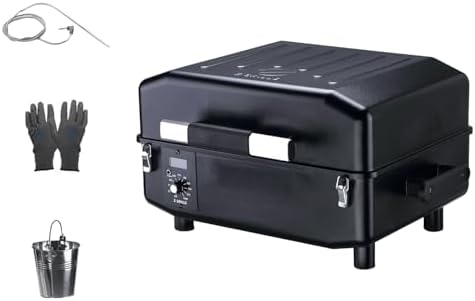
Z GRILLS ZPG-200APro Portable Tabletop Wood Pellet Grill and Smoker, Digital Control, 8 in 1 BBQ Grill for Outdoor Kitchen, Backyard, 202 Sq Inches of Cooking (Black)
A real digital controller, a published 202 square inches of cooking area, and a brand with a parts channel
202 square inches is one rack of ribs, and a tabletop chamber is exposed to every gust of wind
Prices and availability were captured from Amazon Creators API and may change.
How I sort these four
Start with the problem, not the product. A smoke tube answers one question: how do I get more smoke flavor without buying another grill. It works in a gas grill, an electric smoker, a charcoal kettle, or a pellet rig that burns too clean, and it does not ask you to learn a controller or a startup sequence. A tabletop pellet grill answers a different question: how do I cook on pellets without giving up half the patio. Mix those two problems up and you end up buying the wrong thing and blaming the product.
The second thing I sort on is published specs. A listing that tells me the cook area, the controller type, and the material is a listing from a company that expects me to compare it against something else. A listing that says premium and portable and stops there is asking me to trust the box. I have been burned by that enough times to notice the pattern.
Third, parts. Pellet grills have augers, fans, hot rods, and controllers, and every one of those parts eventually fails. A smoke tube has no moving parts, so its only failure mode is rust. That asymmetry matters more than most buyers think when they are staring at two very different price tags. It is also why I keep a tube in the truck even when I am cooking on somebody else's rig.
Smoke tubes: the cheapest flavor upgrade in BBQ
Both tubes here are 12 inches, which is the size that fits across the grate of almost anything without blocking the lid. Fill one with pellets, hit it with a torch for about 45 seconds, let it flame for a few minutes, blow it out, and lay it on the grate. That is the whole technique. The smoke comes off the smoldering column, not a fire, which is why a tube works for cold smoking cheese and for adding a second layer of smoke to a brisket that is already past the stall.
The Smoke Tube for Pellet Smoker with the bonus brush is the one I would hand a beginner. Stainless steel matters here, because the cheap painted tubes rust through at the seam after a couple of seasons, and a rusted tube leaves a metallic edge on the food that no amount of sauce covers. The brush is a small thing that turns out to be a big thing, because a tube that never gets scraped builds a creosote shell inside and stops producing clean smoke. The listing does not publish a burn time, which is the one honest knock against it. One tube also means one tube, so a long overnight cook is a single point of failure unless you buy a spare. Visit on Amazon →
The LIZZQ Premium Pellet Smoker Tube set solves that single point of failure by shipping two. The listing claims five hours of billowing smoke per fill, and if you are running a brisket at 225, five hours covers the window where the meat takes smoke best. Two tubes also let you stagger them: light one at the start, light the second when the first dies, and keep a continuous smoke column going without standing over the grill. The trade-off is that you are paying for redundancy you might not need, and there is no brush in the box, so plan on buying one or using a stiff nylon brush you already own. Visit on Amazon →
Here is the criticism I will level at tubes generally, because it needs saying. A tube does not fix a grill that swings 30 degrees. It adds flavor to an unstable cook, and an unstable cook is still an unstable cook. If your rig cannot hold temp while you sleep, a tube makes the food taste better on the way to being overdone. Fix the fire first.
Tabletop pellet grills: small footprint, real compromises
The Z GRILLS ZPG-200APro is the only product in this group that publishes the two numbers I actually want: a digital controller and 202 square inches of cooking area. Digital control on a tabletop unit is not a gimmick. It is the difference between a grill that holds a setpoint and a grill that drifts while you are inside making a salad, and it is the reason this is the one I would trust with a real cook. The 8 in 1 claim covers the usual list, grill, smoke, bake, roast, braise, and so on, and I care about exactly two of those modes.
The honest limit is the chamber size. At 202 square inches you are looking at one rack of ribs, a spatchcocked chicken, or a couple of tri tips. A full packer brisket will not fit, and if you try to force it you will get a hot spot at one end and a stall that never breaks. Tabletop also means thin walls and a small thermal mass, so wind and cold weather hit this class of grill harder than a cabinet rig. Set it up out of the wind, and if you cook in January, expect to burn more pellets to hold the same setpoint. What you get in return is a real pellet cook on a patio table, and Z Grills has been in the pellet business long enough that parts and support are a known quantity rather than a hope. Visit on Amazon →
The Jocoevol Wood Pellet Smoker Grill is the wildcard, and I want to be straight about why. The listing describes an electric wood pellet grill for backyard and outdoor use, and that is roughly all it commits to. No published cook area, no stated controller type, no material callout. That does not make it bad. It makes it unverified, and unverified is a specific kind of risk in a category where the firepot is the part that decides whether the grill lasts three seasons or ten. If you buy it, do three things before the first cook. Confirm the controller type with the seller, measure the cook area against the food you actually cook, and check that the hopper lid seals, because a lid that lets rain in means wet pellets and an auger jam at hour six. Visit on Amazon →
What the specs actually tell you
Published cook area is the first filter. A grill that tells you 202 square inches is telling you what it is for. A grill that stays quiet on cook area is telling you something too, and it is not flattering.
Controller type is the second filter. Digital control means a setpoint and a temperature readout you can trust enough to walk away from. Anything less and you are managing the cook by feel, which is a fine way to cook and a terrible way to sleep.
Material is the third. Stainless on a tube is rust resistance on a part that sits in ash and moisture. On a grill it is a cost decision the manufacturer made, and the listing usually tells you by omission.
Parts availability is the fourth, and it is the one buyers skip. Tubes have no parts. Grills have augers, fans, hot rods, and boards. Before you buy any pellet grill, find out whether you can order a replacement hot rod without buying a whole new unit.
Which one should you buy first
If you own any grill and your complaint is that the food is not smoky enough, buy the tube. The single 12 inch stainless tube with the brush is the safest first purchase in this group, and it is the one I would give as a gift. If you cook long and you want redundancy without thinking about it, the LIZZQ two pack is the version that keeps a column of smoke going through a full brisket.
If you do not own a grill at all, the math changes. The Z Grills tabletop is the pick because the controller and the published cook area give you a known quantity, and known quantities are how you learn. The Jocoevol is the budget path, and it can work if you are willing to verify the specs and be your own quality control. What I would not do is buy a tabletop grill when the real problem is that your existing grill runs clean. That is a tube problem, and it costs a fraction of the money.
What I am watching next
I am still working through 2026 pellet blends, six brands claiming competition blend with very different results in the smoke ring, and I will have notes on which ones actually produce color. I am also tracking how these tabletop units behave in a 25 mph Kansas wind, because that is the test that separates a controller from a sticker. The tubes, for what it is worth, do not care about the wind nearly as much. They just need to stay lit, and that is a much easier promise to keep.