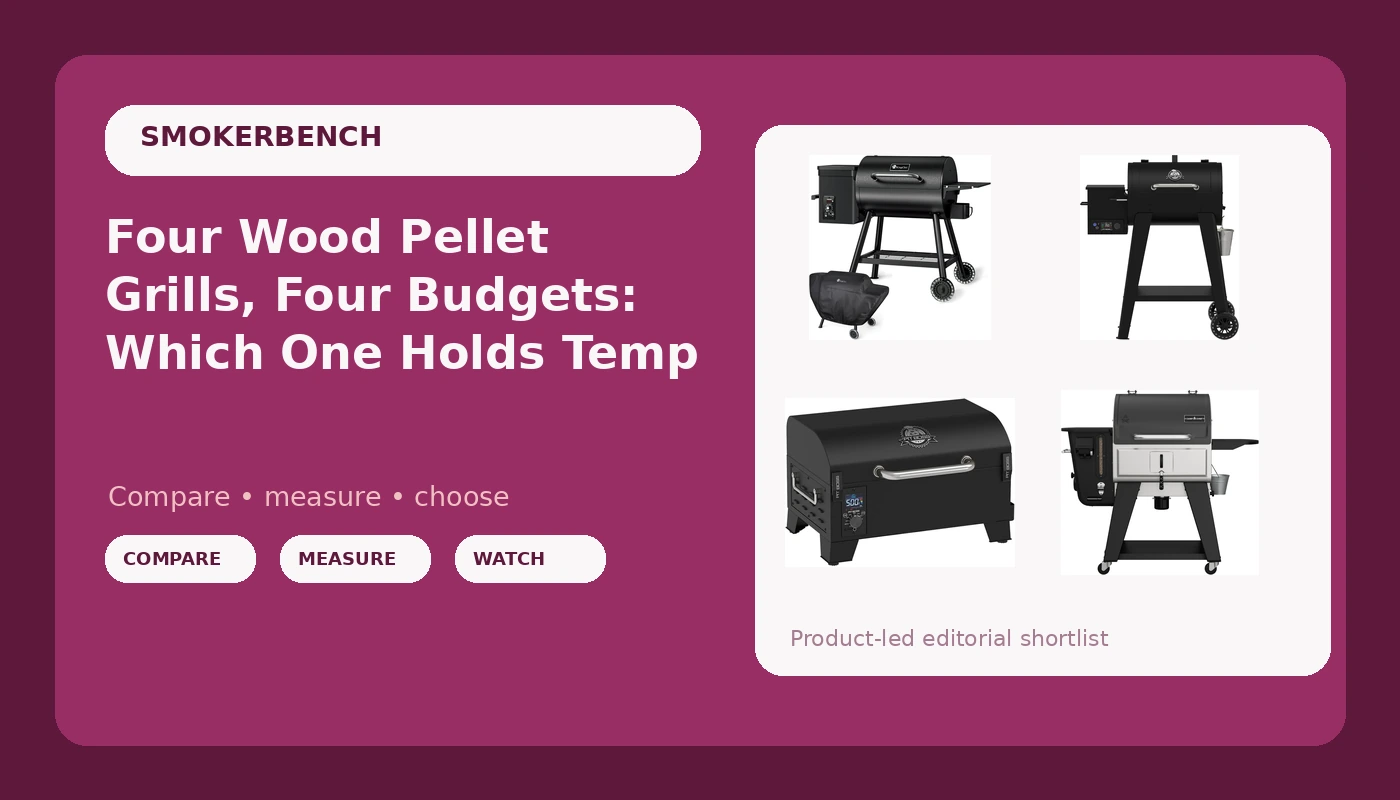
I have judged KCBS contests for more than a decade, and I have kept a temperature log for every cook I have run in twenty years. So when I sit down to write a pellet grill comparison, I start in the same place every time: does the thing hold temp while I sleep. Everything else, the side shelf, the app, the paint job, is garnish. This is a look at four wood pellet grills that cover the entire spread of what backyard cooks actually spend, from a tailgate unit to a premium WiFi rig, and an honest accounting of what each one buys you.
Related: Pellet Grill Temperature Swings Explained
The best pellet grill for most people in this group is the Pit Boss 500 FB2, because 518 square inches and a 500°F ceiling covers a full packer brisket plus sides, and it lands in the middle of the money. That is the short answer. The longer answer is that the right pick depends on whether you cook for two in a driveway or twelve in a backyard, and on whether you are willing to babysit a hopper.
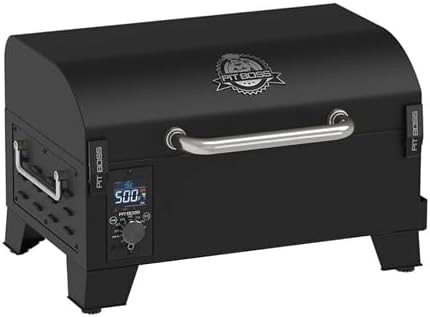
Pit Boss 150 Wood Pellet Grill & Smoker
256 square inches of grill and a 7 lb hopper in a package you can load alone; 180°F to 500°F range and a flame broiler at the entry price
Tiny grate area means one pork butt at a time; thin portable builds are the ones that warp first
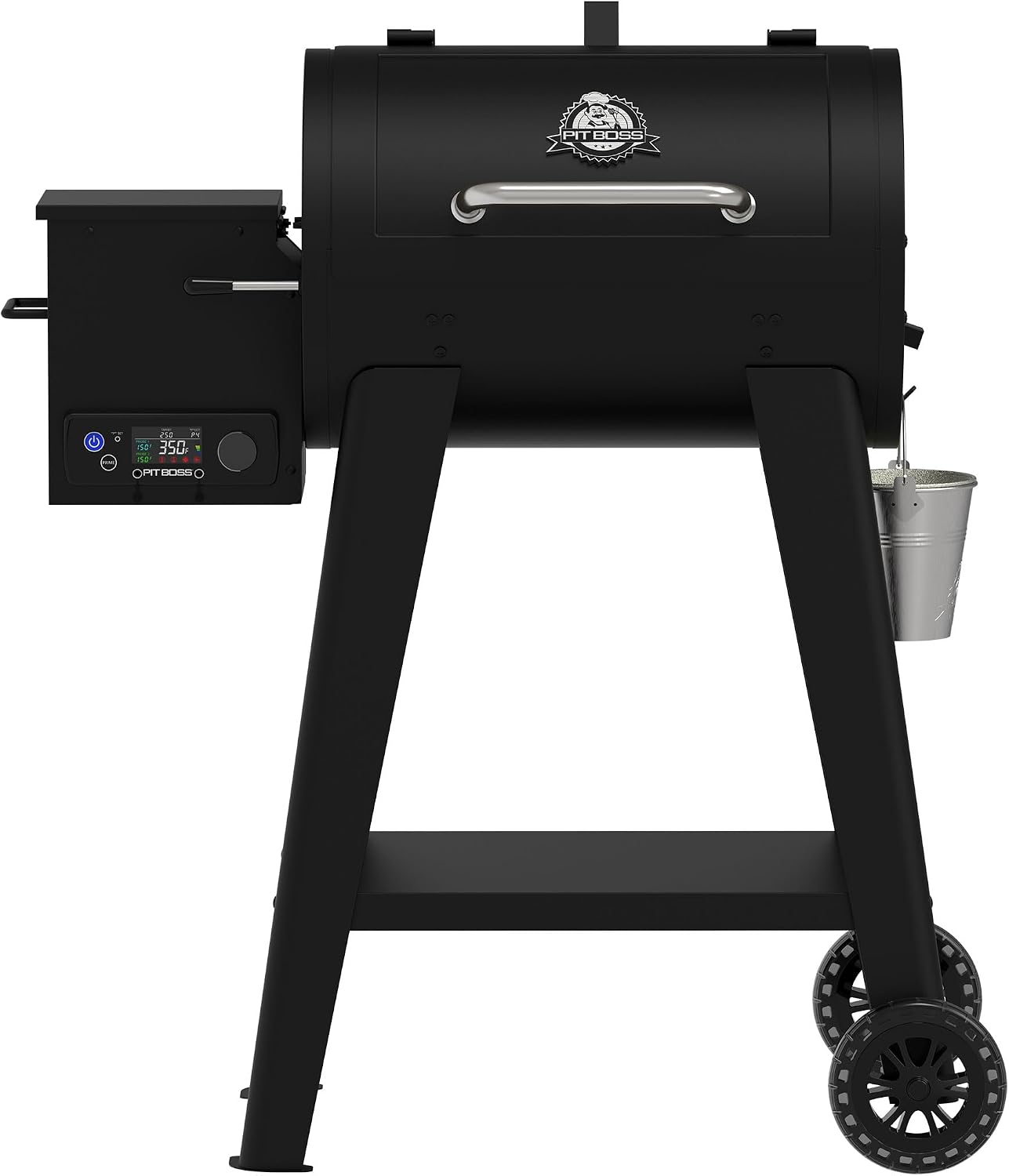
Pit Boss 500 FB2 Series Wood Pellet Grill & Smoker
518 square inches, a 180°F to 500°F range, an LCD controller, a meat probe, and a flame broiler for direct searing
The 5 lb hopper is the weak link on an overnight cook, and Pit Boss firepot welds are the first thing I inspect
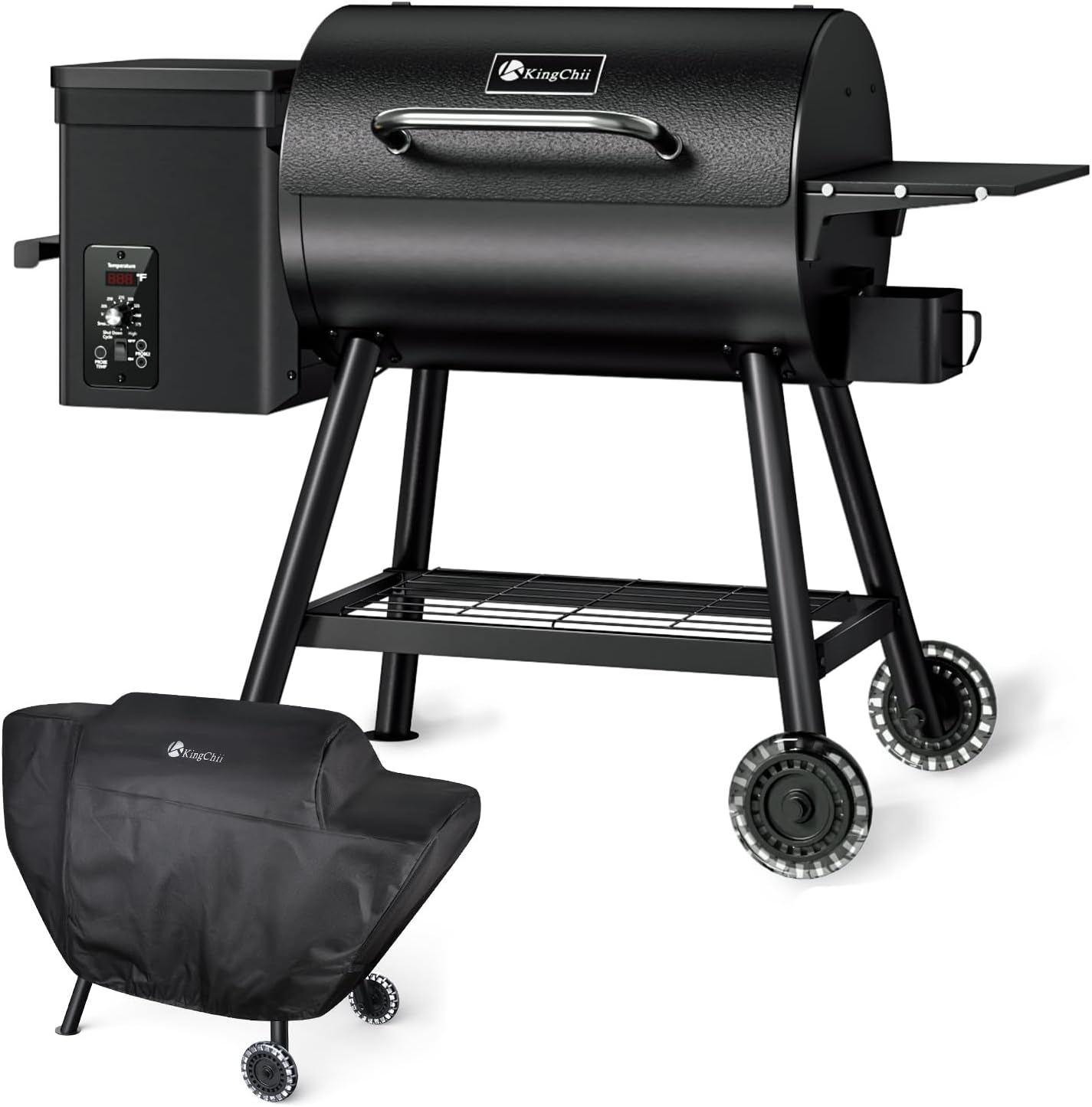
KingChii Electric Wood Pellet Grill & Smoker with Side Shelf
456 square inches and PID temperature control in the budget bracket, plus a side shelf and a cover in the box
The 425°F ceiling rules out a hard sear, and PID controllers on cheap grills live or die on the probe and the auger
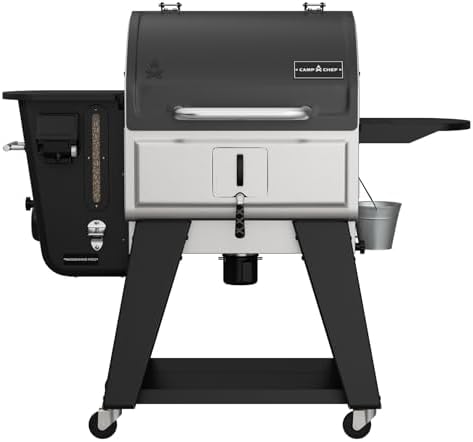
Camp Chef Woodwind Pro WiFi 24 Pellet Grill
The premium build of the group, a 24 inch chamber, and Camp Chef's reputation for easy firepot and ash access
You pay roughly three times the entry price, and WiFi is a convenience, not a feature
Prices and availability were captured from Amazon Creators API and may change.
How I judge a pellet grill
No log, no verdict. That is the rule I have used since I started writing down hold times, and it applies to every grill in this comparison. A manufacturer's box can claim whatever it wants. What matters is what the controller does at hour six, when the outside temperature has dropped twenty degrees and you are asleep.
Four things go through my head before I ever put meat on a new rig. First, can I log the temperature independently of the built-in controller? If there is no way to verify what the grill thinks it is doing, I have nothing to compare. Second, where is the firepot and how thick is the steel around it? Thin steel warps, and a warped firepot lies to the controller for the rest of the grill's life. Third, what is the auger's reputation? Jam stories spread fast in this community because an auger jam at hour six of a brisket ruins a $60 piece of meat and a night of sleep. Fourth, and this is the real test: would I trust it with that brisket at 2 AM?
That is the frame. Now the four grills.
Pit Boss 150 Wood Pellet Grill & Smoker
The Pit Boss 150 is the tailgate and camping answer. It lists 256 square inches of cooking space, a 180°F to 500°F temperature range, a flame broiler, and a 7 lb pellet hopper. That last number is the interesting one. It is bigger than the hopper on the larger Pit Boss in this group, which tells you Pit Boss knows exactly who buys this grill: somebody running it off a truck bed or a campsite, away from a spare bag of pellets.
Two hundred fifty six square inches is one pork butt, one rack of ribs, or a couple of chickens. If your idea of a cook is feeding the block, this is not the grill. If your idea of a cook is four people at a lake, it is exactly the grill, and the 500°F ceiling means you can still finish wings over direct heat with the flame broiler.
The risk on any portable pellet grill is the build. Smaller cookers use less steel, and less steel means more heat loss in wind and more warping at the firepot over time. That is the part of this grill I would inspect first: the welds at the firepot, the lid fit, and whether the hopper lid actually seals against rain. A hopper lid that leaks turns pellets into dust, and dust turns into an auger jam.
Pit Boss 500 FB2 Series Wood Pellet Grill & Smoker
This is my pick of the group for most people. The 500 FB2 lists 518 square inches, a 180°F to 500°F range, an LCD digital controller, a meat probe, a flame broiler, and a 5 lb hopper. That is enough grate area for a full packer plus a pan of beans, and the 500°F ceiling with the flame broiler means it works as a real grill, not just a smoker.
The meat probe is the spec I care about most, because it is the difference between cooking to temperature and cooking to a clock. A brisket does not care what time dinner is. It cares what its internal temp is, and a probe that reads true lets you pull it when it is ready instead of when the recipe said.
The 5 lb hopper is the compromise, and I want to be honest about it. On a long overnight cook at smoking temps, five pounds does not go as far as you want, which means a refill somewhere around the middle of the night. That is a real annoyance, and it is the single spec I would trade up for. If you cook overnight regularly, factor in the refill. If you cook six hour sessions, it is a non issue.
The other thing I check on any Pit Boss is the firepot. The brand is the value king for a reason, and the place that value shows up is in the welds and the steel at the hot end. Look at it before you trust it, and keep the firepot clean. A cheap firepot that is kept clean outlasts a good one that is not.
KingChii Electric Wood Pellet Grill & Smoker with Side Shelf
The KingChii is the budget PID play. It lists 456 square inches, PID temperature control across a 180°F to 425°F range, a side shelf, and it ships with a cover. That is a lot of grill and a lot of control for the bottom of the price ladder, and the cover matters more than people think. Rain is the enemy of pellets and controllers alike.
PID control is the right call in this bracket. A PID controller reads the actual chamber temperature and adjusts the auger feed to correct, rather than running a fixed duty cycle and hoping. When it is tuned well, that is the difference between a grill that swings and a grill that holds. When it is tuned poorly, or when the temperature probe gets coated in grease and ash, it is worse than a simple controller because it is chasing a lie. Clean the probe. Every cook. It takes thirty seconds and it is the whole ballgame.
The 425°F ceiling is the trade off. That is a fine smoking and roasting range, and it will bake, braise, and roast all day. It is not a searing machine. If you want grill marks on a steak, you finish it on a cast iron pan or a gas grill, or you accept a slower sear at 425°F. Know that going in and this grill makes a lot of sense for the money.
Camp Chef Woodwind Pro WiFi 24 Pellet Grill
The Woodwind Pro WiFi 24 is the premium entry here, and it is the one I would buy if the budget were not a consideration. A 24 inch chamber is a real cooking surface, and Camp Chef's reputation in this category was built partly on how easy it is to get at the firepot and the ash. That sounds like a small thing until you have emptied a firepot at midnight in the cold. It is the most useful convenience in the entire category, and it is the reason people who own one tend to stay with the brand.
The WiFi controller is where I part ways with the marketing. I judge on the cook, not the phone. An app that tells you the chamber temp is a convenience, and conveniences are nice right up until the connection drops at 11 PM on an overnight brisket, which is exactly when you wanted it. If the app works, great. If it does not, the grill still has to hold temp on its own. Buy this grill for the chamber, the build, and the firepot access. Treat the app as a bonus.
The price is the honest trade off. You are paying several times the entry price of this group for a better built, better featured grill. Whether that is worth it depends on how often you cook and how much you hate cleaning a firepot.
The trade-offs that actually decide it
Temperature ceiling. Two of these grills top out at 500°F, one at 425°F. If you want to sear on the same machine you smoke on, that 75 degree gap is the whole decision.
Hopper capacity. Five pounds, seven pounds, and whatever the premium chamber holds. Hopper size is a camping spec, not a bragging right, but it decides whether you sleep through the night or set an alarm.
Grate area. 256, 456, and 518 square inches are three different jobs. Match the grate to the crowd, not to the photo on the box.
Build and access. PID control, LCD controllers, meat probes, and flame broilers are all features you can read on a spec sheet. Steel thickness, firepot welds, and how easily you can reach the ash are the things that decide whether you still like the grill in year three.
The app. It is convenience. It is not a feature. Any grill in this comparison still has to hold temp when your phone is in the house.
Which one to buy
Buy the Pit Boss 500 FB2 if you want one grill that smokes a brisket and sears a steak, and you can live with a mid cook refill on long overnight cooks. It is the best balance of grate area, temperature range, and price in this group.
Buy the Pit Boss 150 if you cook for a handful of people and you want to take the grill with you. The 7 lb hopper is a thoughtful spec on a small cooker, and the flame broiler keeps it honest as a grill.
Buy the KingChii if the budget is the hard line and you want PID control and real cooking area for the money. Accept the 425°F ceiling and clean the temperature probe every cook.
Buy the Camp Chef Woodwind Pro WiFi 24 if you cook often, cook long, and want the easiest firepot and ash access in the group. Ignore the app pitch and buy it for the chamber.
What I am watching next
Two things are on my bench right now. First, this year's crop of so called competition blend pellets, six brands with very different results in the smoke ring, and I am logging which ones throw clean heat and which ones throw ash. Second, hold times in wind. A 25 mph Kansas wind will find every thin panel on a grill, and the difference between a cooker that recovers and one that chases is the steel, not the controller. That data is coming.