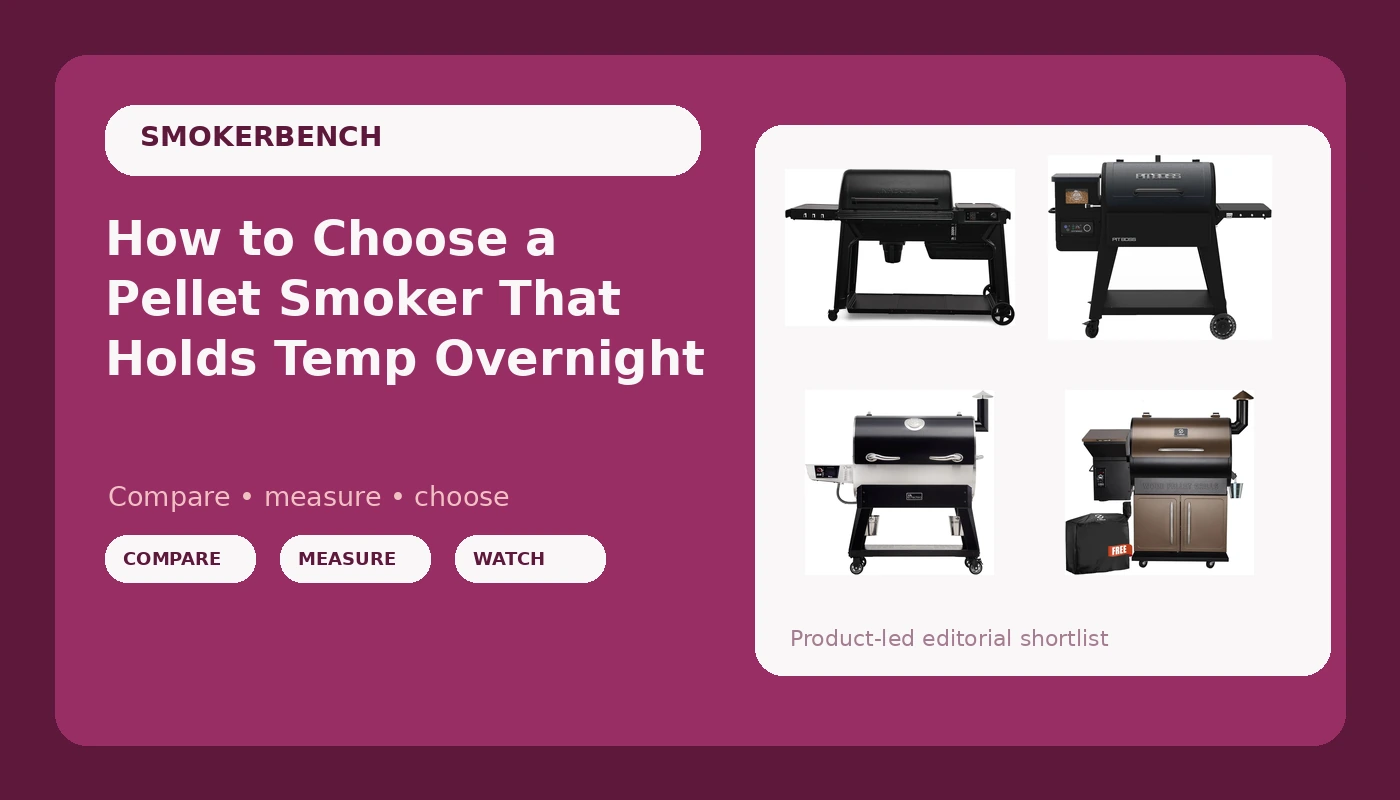
Every pellet grill and smoker on a showroom floor promises the same thing: dial a number, walk away, come back to barbecue. What the spec sheet will not tell you is how the thing behaves at hour six of a brisket, when the wind picks up and the hopper is half empty. That is the gap this article closes. The four models below are four different answers to the same question, and each answer is legitimate depending on how you cook, how many people you feed, and whether you are willing to get up at 2 AM to top off a hopper.
I judge these things on published specs first, because specs are the only thing a buyer can compare before the grill is on the patio. Cook space, published temperature range, hopper capacity, controller type, and what comes in the box. Everything else, including the app, is garnish.
Related: How to Hold Temperature Through a Kansas Wind →
Quick answer
There is no single winner, and anyone who tells you otherwise is selling something. If capacity is your constraint, the recteq Flagship 1600 lists the largest cook space and hopper in this group at 1667 square inches and 40 pounds. If the published temperature range matters most, the Pit Boss 850 Navigator states 180°F to 500°F, the widest figure quoted here. The Traeger Woodridge Pro sits in the middle at 970 square inches with Wi-Fi. The Z GRILLS 2026 Upgrade is the smallest at 700 square inches and the only one of the four that names a PID controller, a built-in storage cabinet, and a rain cover in its listing.
Four useful options
| Model | Best fit | What stands out |
|---|---|---|
| recteq Pellet Grill Smoker - Flagship 1600 | Cooking for a crowd or multiple proteins at once | 1667 sq. in. cook space, 40 lb. hopper, Wi-Fi |
| Traeger Woodridge Pro Wood Pellet Grill & Smoker | Buyers who want a familiar name and mid-size capacity | 970 sq. in. cook space, Wi-Fi |
| Pit Boss 850 Navigator Series | Buyers who want a published temperature range and direct-flame capability | 180°F to 500°F, 30 lb. hopper, flame broiler, meat probe |
| Z GRILLS 2026 Upgrade | Smaller patios and first-time pellet cooks | PID control, 700 sq. in., storage cabinet, rain cover included |
Biggest cook space: recteq Pellet Grill Smoker - Flagship 1600, Wood Pellet Smoker, BBQ, Wi-Fi Smart Grill, 1667 Sq. In. Cook Space, 40 lb Hopper
Hopper capacity is the spec I care about most after temperature behavior, and it is the one buyers ignore. A 40 pound hopper is not about smoking more meat, it is about not refilling at 2 AM on a 14 hour cook. Twenty extra pounds of pellets buys you roughly several more hours of unattended run time depending on your set temperature and the weather, and that is the difference between sleeping and not sleeping. The trade-off is real: 1667 square inches takes up patio space, and a grill this size is not the one you wheel out for two chicken breasts on a Tuesday. If you routinely cook one brisket or two pork shoulders, you are paying for capacity you will not use. If you cook for a crowd or run multiple proteins at once, this is the one in the group built for it.
The familiar middleweight: Traeger Woodridge Pro Wood Pellet Grill & Smoker, 970 Sq In, WiFi
Traeger is the Apple of pellet grills in my book: easy to live with, a closed ecosystem of accessories and pellets, and you pay something for the name. Whether that matters is a personal call. What I can say factually is that 970 square inches is a genuinely useful middle ground, big enough for a full packer brisket with room left for a couple of racks of ribs, small enough that it does not dominate a standard deck. The Wi-Fi is a convenience, not a feature, in my view. I check a temperature graph constantly, but the graph is only as good as the controller feeding it, and no app fixes a firepot that cannot hold a steady auger cycle. Buy this one for the size and the familiarity, not for the phone screen.
The wide temperature range pick: Pit Boss 850 Navigator Series WiFi & Bluetooth Wood Pellet Grill & Smoker, Flame Broiler and LCD Digital Controller, 932-Sq. In. Cook Space, 180°F to 500°F Temp Range, Meat Probe, 30 lb. Hopper
The flame broiler is the detail that separates this from a straight smoker. Sliding the plate open gives you direct heat over the firepot, which means you can sear a steak or finish chicken thighs without dragging a second grill onto the patio. The published 500°F ceiling is what makes that possible, and the 180°F floor is where you live for jerky and long holds. Pit Boss is the value king in this category in my experience, and the place they historically cheap out is weld quality around the firepot, so inspect that area closely when it arrives and before the return window closes. The 30 pound hopper is a reasonable middle figure, smaller than the recteq but well ahead of a 10 pound camp hopper.
The compact starter: Z GRILLS 2026 Upgrade Wood Pellet Grill Smoker with PID Control, Built-in Storage Cabinet, Rain Cover, 700 sq. in Cooking Area for Outdoor BBQ, Smoke, Bake and Roast
PID control is the term worth understanding here, and I explain it below, but the short version is that a PID controller adjusts pellet feed based on how far the temperature has drifted and how fast it is drifting, rather than simply switching the auger on and off at a set point. That is the architecture most likely to hold a tight band overnight. The included rain cover and storage cabinet are small things that matter more than they sound. A hopper lid that does not seal against rain is a genuine problem, and wet pellets turn to dust, and dust causes auger jams. The 700 square inch cooking area is the limitation. It will handle a brisket or a couple of racks, but it is not a competition rig. For a first pellet grill on a smaller patio, that is the right trade.
Prices and availability may change. Product images, names, and retailer links are matched to verified listings. No current price, rating, stock status, or measured result is stated here without current evidence.
Why hold time beats every other number on the box
Hold time is how long the temperature stays put without input. It is the only spec that matters at 3 AM, and it is the one nobody prints. A grill that swings 30 degrees is a campfire with a hopper, no matter how many square inches it claims. Two things drive hold time: the controller logic and the thermal mass around the firepot.
Controller logic first. A simple on/off controller waits for the temperature to fall below a set point, feeds pellets, and waits for it to climb back. The result is a sawtooth graph with real amplitude. A PID controller watches the rate of change and modulates the auger before the temperature drifts far, which flattens the sawtooth. Neither system is immune to weather, and neither is a substitute for a clean firepot.
Thermal mass second. Steel thickness around the firepot and the cook chamber determines how much the ambient temperature can push your cook around. Thin steel warps over time and responds fast to a cold front. In a 25 mph Kansas wind, a thin chamber can lose its band entirely, which is why windbreaks and grill blankets exist.
Pellet quality is the third variable, and it is the one you control. Wet or dusty pellets feed unevenly, which shows up as temperature swings the controller cannot correct. Smoke flavor comes from pellet quality and cook method, not from the size of the firepot. Store pellets sealed, and if the bag smells like sawdust instead of wood, do not put it in the hopper before a long cook.
How to read a pellet grill spec sheet
- Start with cook space in square inches, then ask how many racks that area is split across. A single 700 square inch grate and a 700 square inch area split over two levels cook very differently.
- Check the published temperature range. A low floor matters for jerky and long holds, and a high ceiling matters if you want to sear without a second grill.
- Note hopper capacity in pounds. Ten pounds means you are filling it at 2 AM. Thirty to forty pounds means you are probably not.
- Write down what controls and probes are included: PID versus simple controller, LCD versus dial, single probe versus multiple ports.
- Check what ships in the box beyond the grill. A rain cover, a storage cabinet, and folding shelves are not glamorous, but they change how the grill lives on your patio.
Practical guidance before you commit
- Buy pellets you trust and store them sealed. Humidity turns pellets to dust, dust jams augers, and auger jams at hour six are the single most common way a long cook fails.
- Fill the hopper before you start, not during. Topping off mid-cook is when lids get left open and moisture gets in.
- Plan for wind. A cheap windbreak or a grill blanket does more for temperature stability in open country than any app feature.
- Verify probe placement. A probe sitting too close to the chamber wall reads the wall, not the meat, and it will have you wrapping early for no reason.
- Clean the firepot between cooks. Ash buildup restricts airflow, and restricted airflow is what turns a steady band into a wandering one.
Which option should you choose?
Choose the recteq Pellet Grill Smoker - Flagship 1600 when capacity is your binding constraint and you want the largest cook space and hopper in this group. Choose the Traeger Woodridge Pro Wood Pellet Grill & Smoker when you want a familiar brand, mid-size capacity at 970 square inches, and Wi-Fi in a package that does not dominate the patio. Choose the Pit Boss 850 Navigator Series when you want the widest published temperature range here plus a flame broiler for direct-heat searing, and you are willing to inspect the firepot welds on arrival. Choose the Z GRILLS 2026 Upgrade when you have a smaller space, want PID control named in the listing, and value the included storage cabinet and rain cover over maximum cooking area.
A caveat worth stating plainly: the specs above come from the product listings, not from my own logged cooks on these four units. Square inches, published temperature ranges, and hopper capacities are manufacturer figures, and manufacturer figures are a starting point, not a verdict. The test that actually settles it is a full brisket cook with a temperature graph running, and that is the test I run before I form a hard opinion on any grill.
The bottom line
Match the grill to the cook you actually do, not the cook you imagine doing. If you feed a crowd and hate refilling a hopper, the recteq Flagship 1600 is the capacity answer at 1667 square inches and a 40 pound hopper. If you want a wide published range and the ability to sear over direct flame, the Pit Boss 850 Navigator is the one that lists 180°F to 500°F with a flame broiler. If you want a familiar name and a manageable footprint, the Traeger Woodridge Pro covers the middle at 970 square inches. If you are starting out on a smaller patio, the Z GRILLS 2026 Upgrade pairs a PID controller with 700 square inches and throws in a cover and a storage cabinet. Whichever you pick, the grill that holds temp while you sleep is the one that earns its keep. Everything else is garnish.