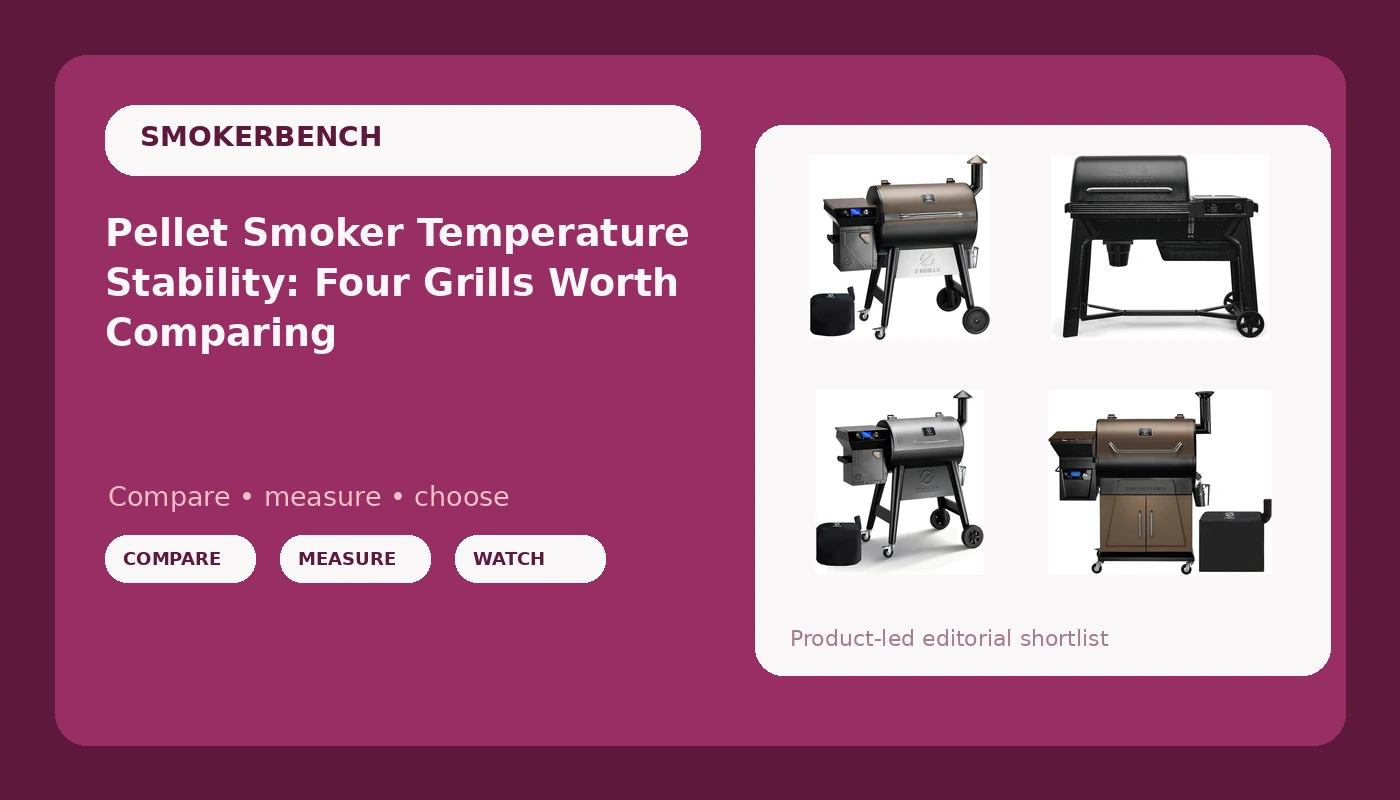
Pellet grills live or die on one number, and it is not the one printed on the box. It is how far the chamber drifts from your set point once the lid is shut and you have gone back inside. Cooks who care about pellet smoker temperature stability end up comparing controllers, cooking area, insulation, and probe support instead of glossy marketing copy, and that is the comparison this page walks through. Four current models sit in the same broad neighborhood and solve the problem four different ways: a mid-size PID workhorse, a large WiFi-equipped cooker, a compact starter grill, and an insulated model that ships with probes and a cover.
Related: Why Your Pellet Grill Swings 30 Degrees (And What to Do About It) →
Quick answer
The Z GRILLS 7002C pairs a 697 square inch cooking area with a PID 3.0 controller. The Traeger Woodridge is the largest cooker in this group at a stated 860 square inches and adds WiFi. The Z GRILLS 450E is the compact option, with a stated 180 to 450°F range on a PID 3.0 controller. The Z GRILLS 700D6 is the feature-forward pick, listing dual-wall insulation, meat probes, an easy hopper clean-out, and a grill cover in the box. Decide your cook size and your typical weather first, then pick the controller generation that fits.
Four options worth comparing
| Model | Best fit | What stands out |
|---|---|---|
| Z GRILLS 7002C Wood Pellet Grill, PID 3.0 Controller,697 in sq | Mid-size cooks who want a familiar PID setup | 697 sq in cooking area with a PID 3.0 controller |
| Traeger Woodridge Wood Pellet Grill & Smoker, 860 Sq In, WiFi | Feeding a crowd or running multiple proteins at once | 860 sq in cooking area plus WiFi connectivity |
| Z GRILLS 450E Pellet Smoker Grill, PID 3.0, 180-450°F Temperature | Small households and first pellet grill | Compact footprint with a stated 180 to 450°F range |
| Z GRILLS 2025 Electric Pellet Grill & Smoker, 700 sq in Cooking Area, Dual-Wall Insulation, PID V2.1 Controller, Meat Probes, Easy Hopper Clean-out, Includes Grill Cover, 8 in 1 Outdoor BBQ, 700D6 | Cold-weather cooks who want the extras included | Dual-wall insulation, PID V2.1, meat probes, hopper clean-out, cover included |
The balanced pick: Z GRILLS 7002C Wood Pellet Grill, PID 3.0 Controller,697 in sq
The 7002C is the grill I would point a cook toward when they want one cooker that handles a brisket on Saturday and burgers on Tuesday. The 697 square inch figure is the number to hold onto: it is wide enough for a packer plus a water pan, but it is not so large that a two-person household is heating empty space for an hour before the food goes on. The PID 3.0 controller is the other half of the story. A PID controller reads chamber temperature continuously and adjusts pellet feed in small corrections rather than cycling on and off around a wide band, which is the difference between a graph that looks like a line and a graph that looks like a saw blade. What the listing does not tell you is how that controller behaves in a Kansas wind at 25 mph, and no spec sheet will. Treat the PID generation as a starting point for your own temperature log, not a promise.
The large-capacity option: Traeger Woodridge Wood Pellet Grill & Smoker, 860 Sq In, WiFi
Traeger has spent years building the most recognizable name in pellet cooking, and you pay something for that recognition. The honest trade-off with the Woodridge is capacity versus footprint: 860 square inches means you can run two pork shoulders and a tray of beans without playing Tetris, and it also means the grill takes up real patio space and burns more pellets to bring a larger chamber up to temperature. The WiFi is a genuine convenience when you are across the yard or inside during a long cook, though I would say the same thing I say about every app in this category: judge the grill on the temperature graph it produces, not on whether the phone buzzes. If your cooks are consistently for a crowd, the extra area earns its keep. If you are smoking one rack of ribs, it is mostly empty steel.
The compact starter: Z GRILLS 450E Pellet Smoker Grill, PID 3.0, 180-450°F Temperature
Here is where I part company with the "buy the biggest grill you can afford" advice. A smaller chamber heats faster, recovers faster after you open the lid, and burns less fuel per cook, which is exactly what a beginner fighting temperature swings needs. The 180 to 450°F range on the 450E covers the two jobs most people actually do: smoke a pork butt at low heat, then crank it up for chicken thighs or burgers. The limitation is capacity, and it is a real one. Two racks of ribs or one moderate brisket is the practical ceiling, and a full packer plus sides is not happening. If you host once a year and cook for two the other 51 weeks, that trade is a good one. If you host every month, it is not.
The insulated upgrade: Z GRILLS 2025 Electric Pellet Grill & Smoker, 700 sq in Cooking Area, Dual-Wall Insulation, PID V2.1 Controller, Meat Probes, Easy Hopper Clean-out, Includes Grill Cover, 8 in 1 Outdoor BBQ, 700D6
Two items on that list matter more than the rest. Dual-wall insulation is the single most useful cold-weather feature a pellet grill can carry, because it slows heat loss through the walls, which is what your controller is fighting on a 30°F morning. And the hopper clean-out addresses the most common failure mode in this hobby: pellets sitting in the hopper for weeks, absorbing humidity, turning to dust, and jamming the auger at hour six of a brisket. Being able to empty the hopper between cooks is a maintenance feature disguised as a convenience feature. The meat probes are a bonus, not a replacement for a reliable third-party thermometer, and the included cover saves you one purchase. The 700D6 is the pick for anyone who cooks through the winter or who has already lost a cook to wet pellets.
Prices and availability may change. Product images, names, and retailer links must be matched by verified ASIN. Do not state a current price, rating, stock status, or measured result without current evidence.
What temperature stability actually means
Temperature stability is not the same thing as a temperature range. A grill that claims 180 to 450°F is telling you where the controller can be set. Stability is what happens after you set it: how tight the chamber holds, how quickly it recovers after the lid opens, and how much it drifts when the wind picks up or the outdoor temperature drops.
Three things drive it. The controller is the first. Older-style controllers work on a simple on-and-off cycle, letting the chamber rise above the set point, cut the auger, and coast back down. A PID controller reads the temperature continuously and makes smaller, more frequent feed adjustments. That is why the PID generations appear in the product names above: PID 3.0 on the 7002C and the 450E, PID V2.1 on the 700D6. The naming differs because manufacturers version their own algorithms, and a higher version number is not automatically a better result.
Insulation and chamber volume are the second factor. Thick walls and a smaller chamber lose heat more slowly, so the controller has less work to do. This is the case for the dual-wall construction on the 700D6 and, in a different way, for the compact chamber on the 450E. A large uninsulated chamber is the hardest case to hold steady, which is why the biggest grill in a lineup is not automatically the most stable one.
Fuel and airflow are the third. Pellet quality, pellet moisture, and how well the firepot breathes all affect the burn. Damp pellets feed unevenly and produce more ash; a firepot clogged with ash starves the fire and the temperature sags no matter how good the controller is. Nothing in a spec sheet covers this, and it is where most "my grill swings 40 degrees" complaints actually originate.
How to read these specs before you buy
The listings give you more information than they appear to. Read them in this order.
- Start with cooking area and translate it into food. A stated 697 or 700 square inches fits a full packer brisket with room to spare. A stated 860 square inches fits multiple proteins at once. A compact grill fits one moderate cook. Match this to your realistic largest cook, not your most optimistic one.
- Check the controller generation and accept that it is a label, not a measurement. PID 3.0 and PID V2.1 tell you the grill uses proportional control rather than a simple on-off cycle. They do not tell you the swing band in degrees.
- Look for insulation if you cook outside of summer. Dual-wall construction is listed on the 700D6 and not on the other three, and that is a meaningful difference for cold-weather cooks.
- Count the included accessories against what you would buy anyway. The 700D6 lists meat probes and a cover. Those are line items you would otherwise add to the cart separately.
- Weigh the maintenance features. An easy hopper clean-out sounds minor until you have chipped damp pellets out of a hopper with a paint stirrer. It is one of the few features that prevents a failed cook rather than improving a good one.
Practical guidance for holding temp
- Buy pellets you trust and store them sealed. Pellet moisture is the most common cause of both temperature swings and auger jams, and it is entirely within your control.
- Keep the firepot clean between long cooks. Ash buildup restricts airflow, and restricted airflow reads on your graph as a sag that no controller setting will fix.
- Log your cooks. A simple notebook or a phone note with set point, outdoor temperature, wind, and any drift is worth more than any spec sheet, because it tells you how your specific grill behaves in your specific yard.
- Cook with the lid down and plan your openings. Every lid lift dumps heat, and a larger chamber takes longer to recover than a small one.
- Add a windbreak or move the grill out of direct wind. Ambient conditions are the variable manufacturers cannot control and the one that most often explains a bad graph.
- Verify doneness with a probe thermometer rather than the chamber reading. Chamber temperature tells you about the grill; internal temperature tells you about the food.
Which option should you choose?
Choose the Z GRILLS 7002C Wood Pellet Grill, PID 3.0 Controller,697 in sq when you want a mid-size PID cooker that handles a full brisket without taking over the patio. Choose the Traeger Woodridge Wood Pellet Grill & Smoker, 860 Sq In, WiFi when capacity and remote monitoring matter more to you than footprint and fuel use. Choose the Z GRILLS 450E Pellet Smoker Grill, PID 3.0, 180-450°F Temperature when you cook for one or two, want a wide stated temperature range, and would rather have a small chamber that recovers fast than a big one that does not. Choose the Z GRILLS 2025 Electric Pellet Grill & Smoker, 700 sq in Cooking Area, Dual-Wall Insulation, PID V2.1 Controller, Meat Probes, Easy Hopper Clean-out, Includes Grill Cover, 8 in 1 Outdoor BBQ, 700D6 when you cook in cold weather, want probes and a cover included, and value the hopper clean-out for keeping pellets dry.
One caveat before you commit: every specification on this page comes from the manufacturer's product listing, not from a logged cook on my patio. Cooking area, controller generation, insulation, probe inclusion, and temperature range are claims to verify against the current listing and against owner reports for your climate. Temperature stability in particular is a behavior, not a bullet point, and it depends as much on your pellets, your wind, and your maintenance habits as it does on the grill.
The bottom line
If pellet smoker temperature stability is your priority, buy for your conditions rather than for the biggest number on the box. The Z GRILLS 7002C is the balanced middle, the Traeger Woodridge is the capacity play, the Z GRILLS 450E is the compact cooker that will teach you the craft without fighting a huge chamber, and the Z GRILLS 700D6 is the one to look at if you cook in the cold and want the insulation, probes, and cover already in the box. Whichever you pick, start a temperature log on the first cook. The graph will tell you more about your grill than any listing ever will.