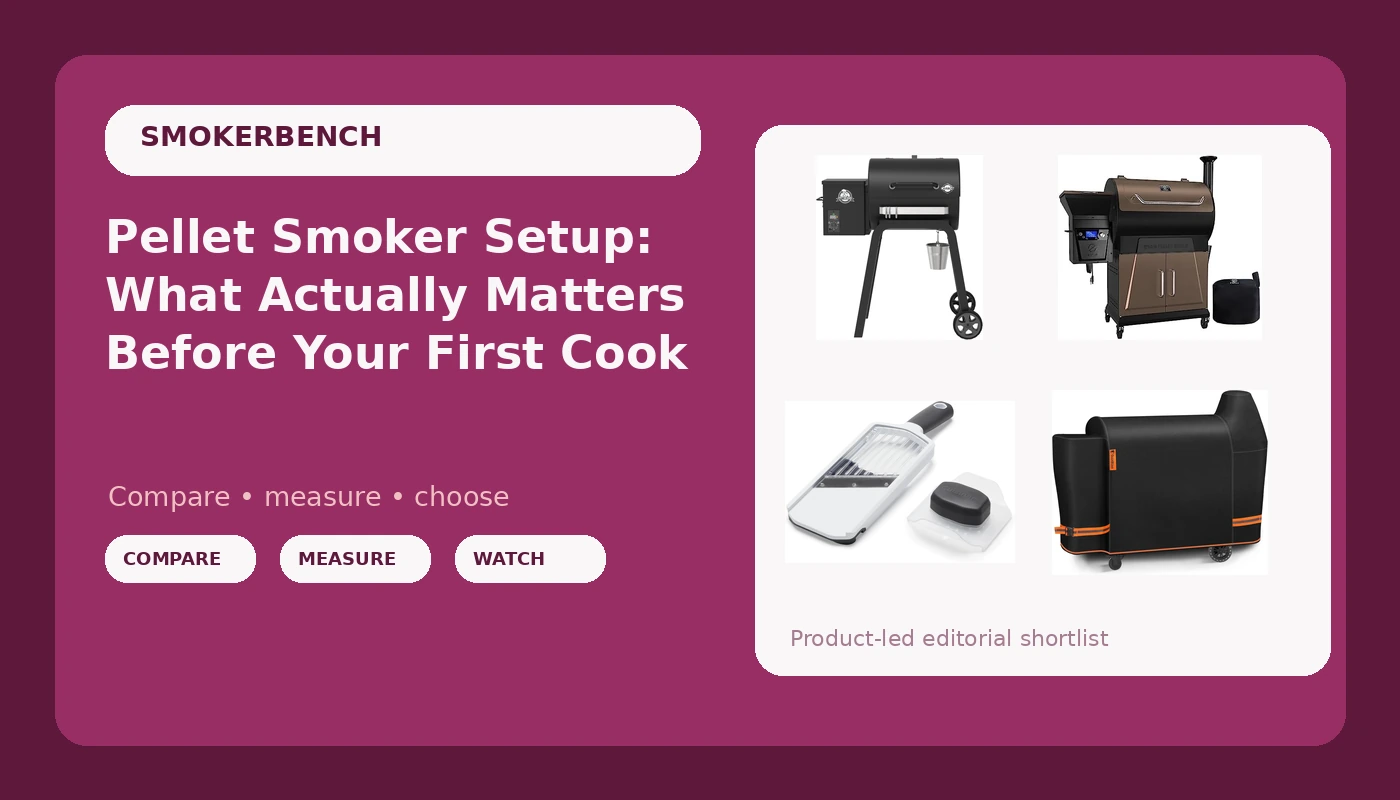
Most people shopping for a pellet smoker spend their entire research budget on the grill and nothing on what surrounds it. Then the first long cook happens, the hopper runs dry before the wrap, the board is buried under onion skins, and the grill spends the off season under a tarp that never quite fit. A pellet smoker setup is really two purchases: the cooker that holds temperature while you sleep, and the small handful of things that keep a long cook from turning into a chain of minor emergencies. This is not a ranking of who builds the finest grill on the market. It is a walkthrough of what each piece in a starter setup actually does, where the money is worth spending, and where it is not.
Related: How to Hold Temperature on a Pellet Smoker Overnight →
Quick answer
A pellet smoker setup starts with a cooker whose controller you can trust for the length of your longest cook, then adds only the items that remove a repeated annoyance: a probe you can rely on, a cover that actually fits your model, and prep tools that make trimming and slicing faster. Two of the four items below are smokers and two are support gear. Match the smoker to your typical cook length rather than your most ambitious one, and buy accessories for the model you actually own, not the model you might upgrade to later.
Four useful options
| Model | Best fit | What stands out |
|---|---|---|
| Pit Boss 500 Carbon Series Wood Pellet Grill & Smoker | A first pellet grill with a wide temperature range | LCD digital controller, 543 sq. in. of cooking space, 180°F to 500°F range, meat probe, 13.5 lb. hopper |
| Z GRILLS 2026 Electric Pellet Smoker & Grill | Overnight cooks and cold, windy sessions | PID 3.0 precision control, 700 sq. in. of cooking space, dual meat probes, 28-hour hopper, dual-wall insulated base, cover included |
| Cuisinart PrecisionSlice Handheld Mandoline Slicer | Prep work while the grill comes up to temp | Handheld mandoline format that stores in a drawer |
| 1000D Heavy Duty Grill Cover for Pit Boss Austin XL Grill | Storing an Austin XL outdoors | 1000D heavy duty fabric sized for the Austin XL |
The starter smoker: Pit Boss 500 Carbon Series Wood Pellet Grill & Smoker
The number that matters most here is not the cooking area, it is the hopper. A 13.5 lb. capacity is a normal size for a grill in this class, and it means the pellet supply, not the controller, sets your practical cook window. On a brisket that runs twelve to sixteen hours, expect to top it off at least once, which is exactly why so many people learn to fill the hopper right before they go to bed rather than right after dinner. The 180°F floor is useful for jerky, smoked cheese, and long holds, and the 500°F ceiling means the same unit can sear or run a griddle attachment if the model supports it. When you look at any Pit Boss, put your hands on the firepot area before you commit. Weld quality and steel thickness at the firepot are where budget builds cut corners, and a warped firepot is a problem you cannot fix with a setting.
The overnight smoker: Z GRILLS 2026 Electric Pellet Smoker & Grill
Three specs on this one deserve attention. First, a PID controller holds temperature by reading the actual pit temperature and adjusting the auger feed continuously, rather than running on fixed timed cycles. That is the difference between a grill that drifts during a weather change and one that corrects for it. Second, a 28-hour hopper is a capacity claim, not a promise about your specific cook, but it does mean a packer brisket will not require a 2 AM refill in the rain. Third, the dual-wall insulated base addresses the thing that ruins more cooks than bad controllers ever do: wind. An insulated body loses less heat to cold air moving across it, so the controller has less work to do and the temperature graph stays flatter. Dual probes also let you track two pieces of meat at once, which is the real reason to care about them on a two-butt cook.
The prep tool: Cuisinart PrecisionSlice Handheld Mandoline Slicer
A slicer is not a smoker part, and that is the point. The long cook is mostly waiting, and the hour you spend waiting is the hour you could spend building slaw, pickled onions, or a potato side. Consistent thickness is what makes those sides work: onions that are all the same width pickle evenly, and cabbage that is shredded uniformly dresses evenly instead of turning to paste at the bottom of the bowl. A handheld unit is the version of this tool that people actually keep using, because it lives in a drawer and comes out without a setup ritual. Use the guard or a cut resistant glove, keep the blade away from the rinse water, and wash it as soon as you are done rather than letting it sit in the sink through dinner.
The storage cover: 1000D Heavy Duty Grill Cover for Pit Boss Austin XL Grill
Fit is the whole story with covers, and this one is model specific. It is made for the Pit Boss Austin XL, which is a different grill from the Pit Boss 500 Carbon Series covered above, so do not assume it will drop onto a smaller or larger cooker. Measure your grill's width, depth, and height including any side shelf before ordering, and check whether your model's chimney or stack needs clearance. Water is the slow killer of pellet grills: it gets into the hopper, turns pellets to dust, and that dust is what jams an auger at hour six of a brisket. If you are buying the Z GRILLS smoker instead, note that it already includes a cover, so this item would be redundant for that grill.
Prices and availability may change. Product images, names, and retailer links must be matched by verified ASIN. Do not state a current price, rating, stock status, or measured result without current evidence.
What actually determines hold time
Hold time is how long the pit stays at your set temperature without any input from you. It is the spec that decides whether you sleep or babysit, and it is not the same thing as the temperature range printed on the box. Four factors drive it.
The controller is the first. A PID controller reads the actual pit temperature and modulates the auger and fan to correct for drift. A simpler timed controller feeds pellets in fixed cycles and simply hopes the average lands near your set point. Both can cook a pork butt, but only one of them reacts when the ambient temperature drops twenty degrees at midnight.
The second factor is insulation and body design. A dual-wall insulated base reduces heat loss to moving air. On a windy patio, an uninsulated grill loses heat faster than the controller can replace it, and you see that as a wider temperature graph rather than as an obvious failure.
The third is hopper capacity. A 28-hour hopper and a 13.5 lb. hopper are both honest specs, but they describe different cook lengths before a refill. Capacity is the cheapest insurance you can buy against a 2 AM wake up.
The fourth is pellets. Long or damp pellets, or pellets that have been sitting in an open bag since last fall, feed unevenly and produce more dust. Damp dust is the leading cause of auger jams, and no controller can fix a fuel problem.
Where accessories fit in a setup
Accessories are worth buying when they remove a repeated annoyance, and not before. A cover is worth it the moment your grill lives outdoors. A probe is worth it the first time you cook two pieces of meat to different target temperatures. A slicer is worth it the first time you make slaw for a crowd.
What is not worth buying early: remote thermometers you will not calibrate, extra probe clips, and anything that promises a specific smoke ring. The smoke ring is a cosmetic band created by a chemical reaction at the surface of the meat. It comes from cook temperature, surface moisture, and the wood itself. No gadget manufactures it, and judges do not score it in most categories.
One practical note on covers and probes alike: buy for the grill you own. Accessory fit problems are the most common reason a purchase sits in the garage, and a cover that is one model off is worse than no cover at all because it traps moisture underneath.
- Decide your realistic longest cook. Twelve hours and twenty hours lead to different smokers.
- Check the controller type first. PID control is the pattern to look for on long cooks.
- Compare hopper capacity against that cook length, not against the biggest number on the page.
- Inspect the firepot and body steel on any budget grill before you commit.
- Add accessories one at a time, starting with a cover and a probe, and only when a cook shows you the need.
Practical guidance before you order
- Measure your patio space including the lid swing and any side shelf before choosing a model.
- Confirm the cover is cut for your exact grill model, since covers are rarely interchangeable across sizes.
- Buy pellets in sealed bags and store them sealed, because humidity is what turns pellets into auger jam.
- Plan your first long cook for a calm day so you learn the grill without fighting the wind.
- Keep the firepot and ash area clean between cooks, since ash buildup affects how the next cook behaves.
- Register the grill and keep the receipt, because controller and auger issues usually show up in the first season.
Which option should you choose?
Choose the Pit Boss 500 Carbon Series Wood Pellet Grill & Smoker when you want one cooker that covers low and slow smoking at 180°F and hotter grilling up to 500°F, and you are comfortable topping off a 13.5 lb. hopper during a long cook. Choose the Z GRILLS 2026 Electric Pellet Smoker & Grill when your cooks routinely run overnight or through cold and windy weather, and the combination of PID 3.0 control, a 28-hour hopper, and a dual-wall insulated base matters more to you than a lower entry point. Choose the Cuisinart PrecisionSlice Handheld Mandoline Slicer when sides and garnishes are part of your cook routine and you want consistent slices without another counter appliance. Choose the 1000D Heavy Duty Grill Cover for Pit Boss Austin XL Grill when an Austin XL is the grill on your patio and it lives outdoors.
One caveat on evidence: this article describes what the manufacturers specify, not what I measured. Published specs tell you the range, the capacity, and the control type, but they do not tell you how a specific unit behaves in your wind, at your altitude, with your pellets. Verify the fit and the specifications on the product page for your exact model before ordering, and treat any claim about how a grill performs in real conditions as something you will confirm on your own first cook.
The bottom line
A pellet smoker setup is one decision about the cooker and three small decisions about everything around it. The cooker choice comes down to hold time: controller type, insulation, and hopper capacity are the three specs that decide whether you sleep through a brisket or check the graph every twenty minutes. Between the two smokers here, the Pit Boss 500 Carbon Series covers a wider temperature range in a smaller footprint with a 13.5 lb. hopper, while the Z GRILLS 2026 is specified around unattended cooking with PID 3.0 control, a 28-hour hopper, and an insulated base. The accessories are simpler: a mandoline earns its drawer space the first time you make slaw for a crowd, and a model specific cover earns its place the first time it rains on a grill you forgot to tarp. Start with the cooker that matches your longest realistic cook, add the cover, and let the rest of the setup prove itself one cook at a time.