Most people start a pellet smoker setup by comparing cooking surface numbers, and that is the least useful place to start. The spec that decides whether you enjoy this hobby is hold time: how long the grill sits at your setpoint without you standing over it in the dark. Everything else, the app, the paint, the badge on the lid, is garnish.
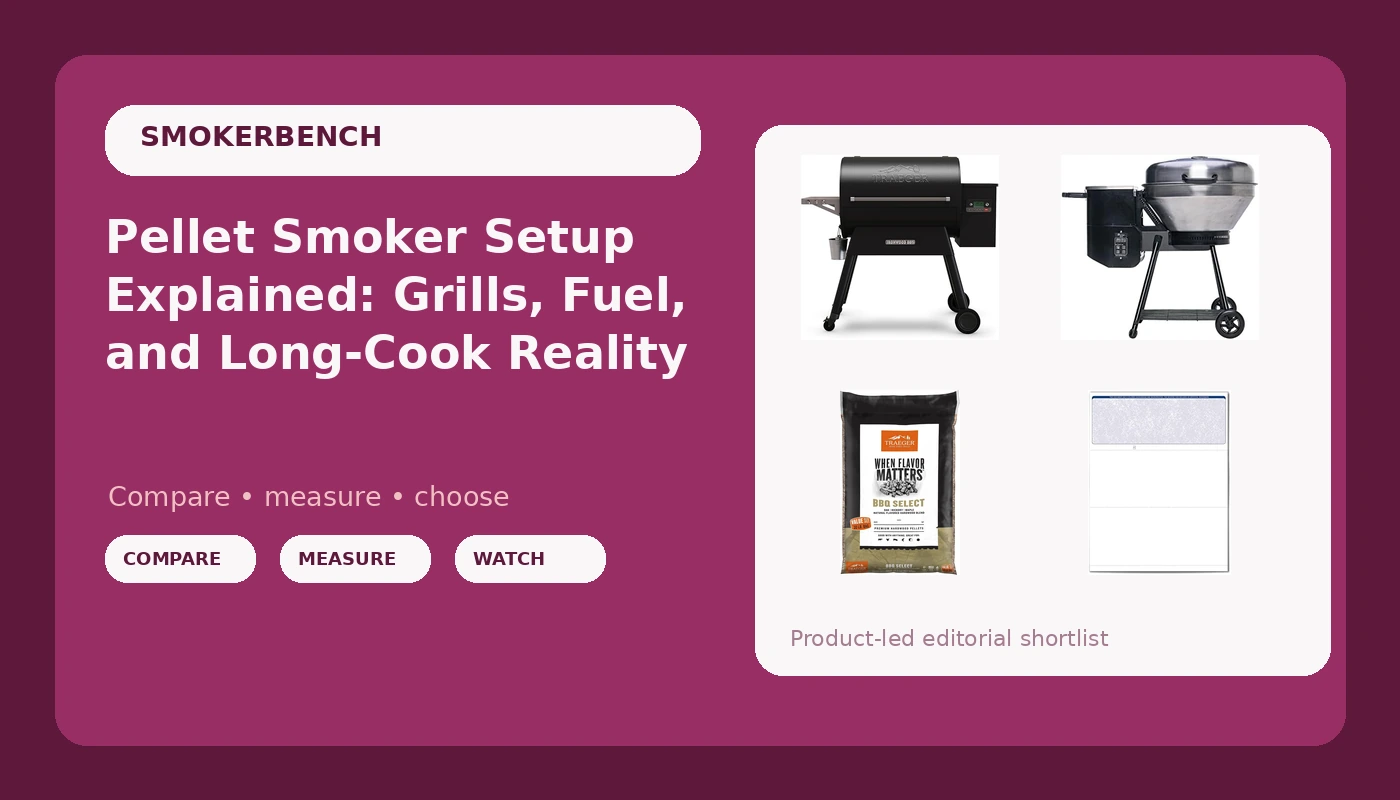
This is an explainer, not a shootout. It walks through the four listings in this set, three of which are pellet smoking gear and one of which is not, and it covers what actually goes into a pellet smoker setup: the grill, the controller, the firepot, and the fuel.
Related: How to Hold Temp Through a Kansas Wind →
Quick answer
A pellet smoker setup is three parts: a grill with an auger, fan, and firepot; a controller that feeds pellets to hold a set temperature; and the wood pellets themselves. Match cooking surface to how much meat you cook at once, pay for searing capability only if you will actually use it, and buy pellets you will burn within a season. The VersaCheck listing included in this set is business stationery and has nothing to do with smoking.
Four listings, sorted by what they actually do
| Model | Best fit | What stands out |
|---|---|---|
| Traeger Ironwood 885 Wood Pellet Grill & Smoker, 885 Sq In, WiFi | Long cooks and large cuts | 885 square inches of cooking surface and WiFi monitoring, both named in the listing |
| recteq Pellet Grill RT-B380 Bullseye | Everyday grilling and searing | Uses 100% wood pellets, with sear and smoke both listed as uses |
| Traeger Grills BBQ Select 100% All-Natural Wood Pellets, 30 lb. Bag | Fuel for a pellet grill | 100% all-natural wood pellets in a 30 lb bag |
| VersaCheck ValueChex, 500 Blank Business Voucher Checks | Business paperwork, not smoking | 500 blank checks in a check-on-top layout |
The big-cook option: Traeger Ironwood 885 Wood Pellet Grill & Smoker
Surface area is the whole point here, and it is also the whole cost. A bigger chamber takes longer to come up to temperature, burns more fuel per hour to hold that temperature, and takes up more patio. What it buys you is the ability to lay a packer brisket and a couple of butts side by side without crowding, and crowding is what kills airflow. When meat is jammed against the walls, the hot spots turn into hot spots you can taste.
The other thing to think about is the app. WiFi on a grill is a convenience, not a feature. It tells you what the controller already knows, and it is only as good as the probe placement and the connection. Judge this grill on whether it holds temp while you sleep, not on whether the graph loads on your phone.
The everyday option: recteq Pellet Grill RT-B380 Bullseye
Searing on a pellet grill is a real capability and a different job from smoking. A sear happens close to the firepot at high heat, and a smoke happens in a chamber held low and steady for hours. Grills that do both tend to be smaller and more direct, which means faster preheat and less fuel per cook, and it also means less thermal mass to smooth out a gust of wind. That trade is the honest one: the compact cooker is easier to live with on a Tuesday and less forgiving on a 14-hour brisket in February.
If most of your cooks are weeknights, chicken, burgers, and a rack of ribs, this is the shape of grill that gets used instead of admired.
The fuel: Traeger Grills BBQ Select 100% All-Natural Wood Pellets, 30 lb. Bag
A 30 lb bag is a sensible unit because it is enough for a real cook without being a pallet. What matters more than the brand on the bag is how the pellets were stored before they reached you and how you store them after. Pellets that have taken on moisture swell, crumble, and turn into dust, and dust is what bridges in the hopper and stalls the auger. Keep the bag sealed, keep it off a concrete floor, and rotate your stock so you are not burning last spring's fuel in November.
The listing that is not smoker gear: VersaCheck ValueChex, 500 Blank Business Voucher Checks
It is in this article because it was in the same set of listings, and pretending it belongs in a conversation about firepots would waste your time. If you run a small business and need check stock, it is check stock. If you came here for smoke, skip it.
Prices and availability may change. Product images, names, and retailer links must be matched by verified ASIN. Do not state a current price, rating, stock status, or measured result without current evidence.
How a pellet grill actually holds temperature
Every pellet grill runs the same basic loop. A controller reads a temperature probe inside the chamber, compares that reading to your setpoint, and turns the auger to drop pellets into the firepot. A fan pushes air through the pot so the pellets combust, and the resulting heat and smoke move through the chamber and out the stack. The controller's only real job is deciding how many pellets to feed and how often.
That loop explains almost every problem people blame on the brand. If the probe sits in a spot that reads hotter or cooler than where the meat is, the controller will hold the wrong temperature confidently. If the firepot is thin steel, it warps over a few seasons and the airflow pattern changes. If the lid does not seal, wind pulls heat out faster than the auger can replace it. If the chamber is large and lightly built, a 25 mph gust turns a steady cook into a sawtooth.
This is why hold time is the spec I care about and the one nobody prints on the box. Hold time is how long the grill stays within a useful band of your setpoint without input, through a stall, through a weather change, through the two hours you slept. A grill that swings 30 degrees is not smoking, it is guessing. Surface area, app features, and paint color are all downstream of that one behavior.
Why pellets and the firepot decide your smoke
Smoke flavor comes from the fuel and the burn, not from the size of the firepot. Clean combustion of dry wood pellets produces thin, sweet smoke. A starved or smoldering fire produces the acrid, creosote-heavy smoke that makes people think they do not like smoked meat. Both can happen in the same grill on the same afternoon depending on airflow and pellet condition.
Pellet quality is the part you control. Species and blend set the flavor profile, moisture content decides whether the pellets feed or crumble, and the amount of fines in the bag decides how often you clean the hopper. None of that is printed prominently, which is why a community of people who compare notes is more useful than a marketing page.
The smoke ring is a separate thing. It is the pink band under the bark, it is mostly cosmetic, and everybody obsesses over it anyway. A good ring comes from a clean burn and a moist surface early in the cook, not from a bigger fire.
Here is the order I would work through before buying anything:
- Measure how much meat you actually cook at one time, not how much you would cook for a party you host twice a year.
- Decide whether you need direct-heat searing or only low-and-slow smoking, because that decision eliminates half the field.
- Ask whether you can log the chamber temperature over a full cook, because no log means no honest verdict on anything.
- Look at the firepot and the steel around it, since that is where cheap construction shows up first.
- Budget for fuel and airtight storage before you budget for accessories, because pellets are a recurring cost and a jam is a ruined brisket.
Practical guidance
- Buy pellets in a quantity you will burn within a season, and store them sealed and off a concrete floor.
- Dump the last of a bag into a bucket and check for dust instead of pouring fines straight into the hopper.
- Run a dry cook with an empty chamber and a temperature log before you trust the grill with an expensive piece of meat.
- Check the hopper lid seal, because rain and humidity cause more auger jams than anything else.
- Keep the firepot and the ash that surrounds it clean, since ash buildup changes airflow and airflow changes temperature.
- Set up out of the wind or build a simple wind break, because a steady breeze will beat a controller every time.
Which option should you choose?
Choose the Traeger Ironwood 885 Wood Pellet Grill & Smoker when you cook for a crowd or want to lay out a packer and a couple of butts at once, and when the WiFi monitoring is a genuine convenience for your setup. Choose the recteq Pellet Grill RT-B380 Bullseye when your cooks are smaller and more frequent, and when you want searing and smoking from one outdoor electric pellet grill. Choose the Traeger Grills BBQ Select 100% All-Natural Wood Pellets, 30 lb. Bag when you need fuel for whichever grill you end up with, because pellets are not brand-locked to the cooker. The VersaCheck ValueChex checks are not a choice in this category at all; they are business stationery that happened to share a listing set.
One caveat on all of this. The listings describe surfaces, fuels, and features, and those are the only things I can speak to without a temperature log from a full cook. How a specific grill performs in your yard, in your wind, with your pellets, is a question only your own graph can answer.
The bottom line
A pellet smoker setup is a grill, a controller, and a bag of fuel, and the only one of those three that is hard to fix later is the grill. Buy cooking surface that matches your real cooks, treat WiFi as a convenience rather than a reason to buy, keep your pellets dry, and keep the firepot clean. Then log the temperature on your first long cook and let the graph tell you whether you bought a smoker or a campfire with a hopper.