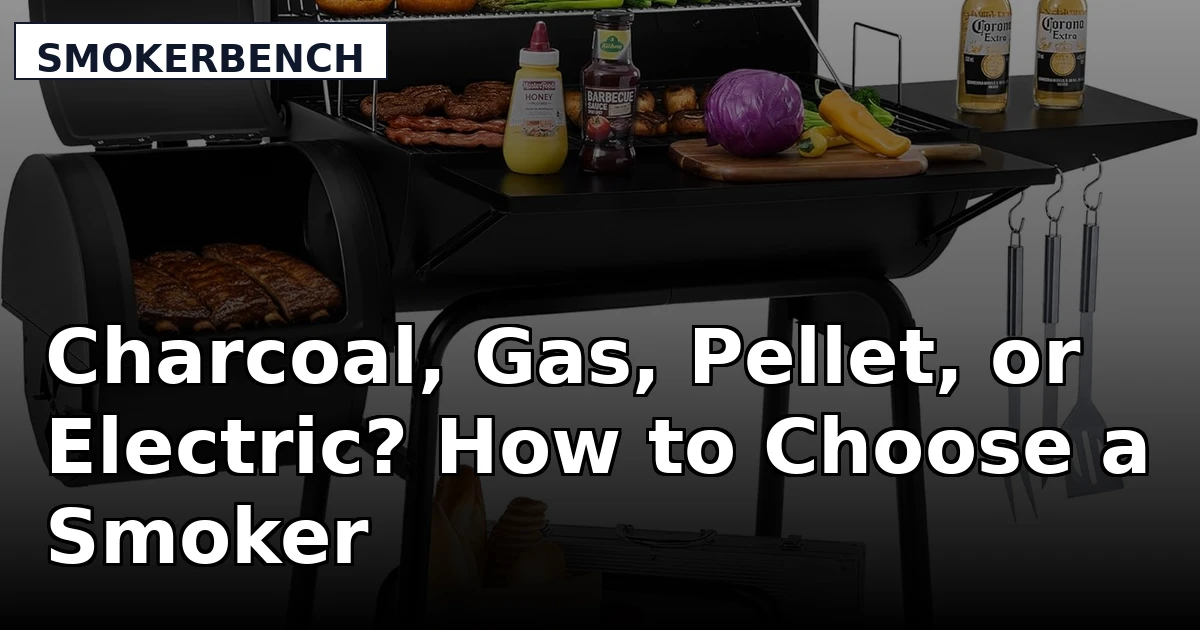
There is no single best smoker, and anyone who tells you there is has something to sell you. What exists instead is a short list of fuel types, each one demanding a different kind of attention from the person standing next to it. This smoker and grill buying guide sorts four products into the four real starting points, charcoal and offset, propane, electric, and the pellet path, and explains what each one asks of you on a Saturday when you have a brisket on and the wind picks up.
I judge a cooker by one thing before anything else: can I log the temperature, and does it hold. The app is a convenience. The paint is decoration. If the chamber swings while you sleep, none of the rest of it matters. So the real question is not which grill is best. It is which grill matches the cook you are actually going to do, on the days you actually cook.
Related: Pellet Grill Temperature Stability: What the Graph Actually Tells You →
Quick answer
Match the fuel to the cook, not to the marketing copy. For charcoal and offset smoke where you manage the fire yourself, the Royal Gourmet CC1830S is the entry point. For propane convenience with a stated path toward pellets, the Broil King Baron 420 Pro Shadow is the gas option. For electric, portable cooking with seven modes and no fuel handling at all, the Ninja Woodfire OG701 covers it. And for keeping whichever one you buy in working order, the Traeger BAC679 cleaner pack handles the part nobody photographs.
Four useful options
| Model | Best fit | What stands out |
|---|---|---|
| Royal Gourmet CC1830S BBQ Charcoal Grill and Offset Smoker | Cooks who want to run charcoal and manage the fire themselves | A charcoal grill and offset smoker in one unit, described for outdoor and camping use |
| Broil King 674114 Baron 420 Pro Shadow | Backyard cooks who want propane now and pellets later | Four burners, propane fueled, and described by the maker as pellet ready |
| Ninja OG701 Woodfire Outdoor Grill & Smoker | Small patios, renters, and anyone avoiding fuel handling | Electric and portable, 7-in-1 with grill, smoker, air fryer, bake, roast, dehydrate, and broil modes, plus one pack of Woodfire Pellets |
| Traeger Grills BAC679 Grill Cleaner Spray Bottle | Anyone who owns one of the three above | Two 946ml bottles, citrus scent, described as a grease cutter made without harmful chemicals |
Charcoal and offset: Royal Gourmet CC1830S BBQ Charcoal Grill and Offset Smoker
Here is the trade you are making. With an offset, you are the thermostat. There is no controller, no fan, no auger feeding fuel on a schedule. You load charcoal, you watch the stack, you adjust the intake, and you learn what your cooker does when the wind shifts. That is either the whole appeal or a dealbreaker, and only you know which. The upside is that you learn fire management on a cooker that will never hide a mistake from you. The downside is that a charcoal offset does not hold temperature for you while you sleep, which means an overnight brisket is a commitment, not a convenience. If you want the craft and you want the cheapest way into real smoke flavor, this is the lane. If you want to sleep, keep reading.
Propane, pellet ready: Broil King 674114 Baron 420 Pro Shadow 4-Burner Pellet Ready Propane Gas Grill
Gas is the fuel that shows up. It lights in minutes, it runs from low to high without you feeding it anything, and it handles the Tuesday night burgers and the Saturday afternoon chicken without a chimney of charcoal or a hopper full of pellets. What gas does not do on its own is produce the long, low smoke that a brisket wants. That is why the "pellet ready" description on this one is the detail worth noticing. It means you are not choosing between propane convenience and pellet smoke forever, you are choosing which one comes first. My own rule applies here as it does everywhere: judge the frame and the burners now, and judge the pellet side later, on the graph, once you are actually running it.
Electric and portable: Ninja OG701 Woodfire Outdoor Grill & Smoker
This is the option for the person who does not have a propane tank, does not want a bag of charcoal in the garage, and does not want to babysit a fire. Plug it in, add Woodfire Pellets, and the heat source and the smoke source are handled by the unit rather than by you. The portable build is aimed at patios, small yards, and camp setups rather than a full-size backyard rig, and the seven modes mean you are buying one appliance instead of stacking a grill, a fryer, and a dehydrator on the same slab. The honest trade-off is scale and fuel. This is a pellet system designed around this unit, not a hopper-fed auger smoker, so do not expect it to behave like one on a fourteen-hour cook. Expect it to do a lot of different jobs well in a small space, which is exactly what most weeknights call for.
The upkeep item: Traeger Grills BAC679 Grill Cleaner Spray Bottle
Nobody writes a love letter to grill cleaner, and that is exactly why it belongs in a buying guide. The difference between a cooker that runs for eight seasons and one that quits in three is almost never the badge on the lid. It is grease left in the path, ash left in the firepot, and a grate that never got scraped. On a pellet grill, a dirty firepot is how you get an auger jam at hour six. On charcoal, leftover ash is how you get a fire that will not breathe. On gas, grease in the wrong channel is how you get a flare that ruins dinner. A citrus grease cutter and a stiff brush are cheap insurance against all three. Buy it with the grill, not after the first problem.
Prices and availability may change. Product images, names, and retailer links must be matched by verified ASIN. Do not state a current price, rating, stock status, or measured result without current evidence.
What actually decides whether a smoker works for you
Fuel type is the first fork in the road, but it is not the whole decision. The things that separate a cooker you love from one you resent are temperature stability, how the fire is fed, where the unit lives, and what it asks of you after the cook.
Temperature stability is the spec that matters and the one nobody prints on the box. A cooker that holds steady for hours lets you sleep, plan a timeline, and wrap when you meant to wrap. A cooker that swings turns every cook into a rescue mission, and you can taste it in the final product even when the smoke ring looks fine. This is why I want a log, not a marketing number. Show me hold time across a real cook in real weather.
Fuel delivery matters just as much. Charcoal asks you to manage the fire by hand. Propane asks almost nothing and gives instant range. Electricity asks for an outlet and gives repeatable heat. Pellets ask for dry fuel and a clean firepot, and they reward you with hands-off hours. Every one of those is a different relationship with your Saturday.
Then there is placement. A grill on a covered porch in a wind shadow behaves nothing like the same grill on an open slab in a 25 mph Kansas wind. If your cooker lives in the open, you are buying stability against weather, not just against fuel. And finally, cleanup. Grease, ash, and pellet dust are the three things that quietly kill cookers. Plan for them at purchase and the unit lasts.
Matching the fuel to the cook you actually do
Charcoal and offset cooking is a skill purchase as much as a hardware purchase. You will learn draft, fuel load, and fire size, and you will get better at it because the cooker gives you no choice. It is the most direct route to real smoke flavor and the least forgiving on a timeline.
Propane is the opposite trade. You give up the long, low smoke unless you add a smoke source, and in return you get a grill that is ready in minutes and never needs a chimney. For a household that grills three nights a week and smokes four times a season, that math is hard to beat.
Electric is the quiet option. It needs an outlet and a covered spot for rain, and it does not care about wind the way a fire does. It suits balconies, small patios, and renters who cannot store fuel. Pellet feeding, whether in a hopper-fed smoker or a unit that burns Woodfire Pellets, sits in the middle: more smoke than gas, less attention than charcoal, with dryness and firepot cleanliness as the price of admission.
- Write down the last three things you actually cooked outside, not the three you plan to cook.
- Pick the fuel you are willing to manage at 6 AM and again at 11 PM.
- Decide where the cooker lives: outlet, propane storage, rain cover, wind exposure.
- Budget the consumables and the cleanup, not just the unit itself.
- Buy for your worst-weather cook, not your best one, because that is the cook that decides whether you trust the grill.
Practical guidance
- Log the temperature on every cook. A graph tells you more about a cooker than any spec sheet.
- Keep pellets and charcoal dry. Humidity turns fuel into dust, and dust turns into a jam.
- Empty the firepot and the ash pan on a schedule, not when something goes wrong.
- Scrape the grate while it is warm and cut the grease before it sets up in the channels.
- Do not chase the app. Check the graph, then go back to bed, or fix the fire.
Which option should you choose?
Choose the Royal Gourmet CC1830S BBQ Charcoal Grill and Offset Smoker when you want to learn fire management and you are happy to trade sleep for craft. Choose the Broil King 674114 Baron 420 Pro Shadow 4-Burner Pellet Ready Propane Gas Grill when propane convenience is the priority and you want the option to move toward pellet smoke later on the same frame. Choose the Ninja OG701 Woodfire Outdoor Grill & Smoker when space, portability, and an electric plug matter more than chamber size, and you want grill, smoker, air fryer, and more in one appliance. And choose the Traeger Grills BAC679 Grill Cleaner Spray Bottle regardless of which one you buy, because all three of the others depend on grease and ash being dealt with.
One caveat worth stating plainly: I do not rate a cooker without a full cook and a logged temperature graph, and nothing here replaces that. Fuel type, burner count, and mode lists describe what a unit is built to do, not how it performed on my patio. Treat the descriptions above as the starting point for your own shortlist, then verify the details that matter to you on the current product page.
The bottom line
Buy the fuel, not the badge. Charcoal and offset gets you craft and control with your hands on the fire. Propane gets you a grill that is always ready and a path toward pellets if you want it later. Electric and portable gets you seven modes, no fuel handling, and a footprint that fits a patio. Whichever you pick, the grill that holds temperature while you sleep is the one you will still be using in five years, and the one you clean is the one that will still hold it.