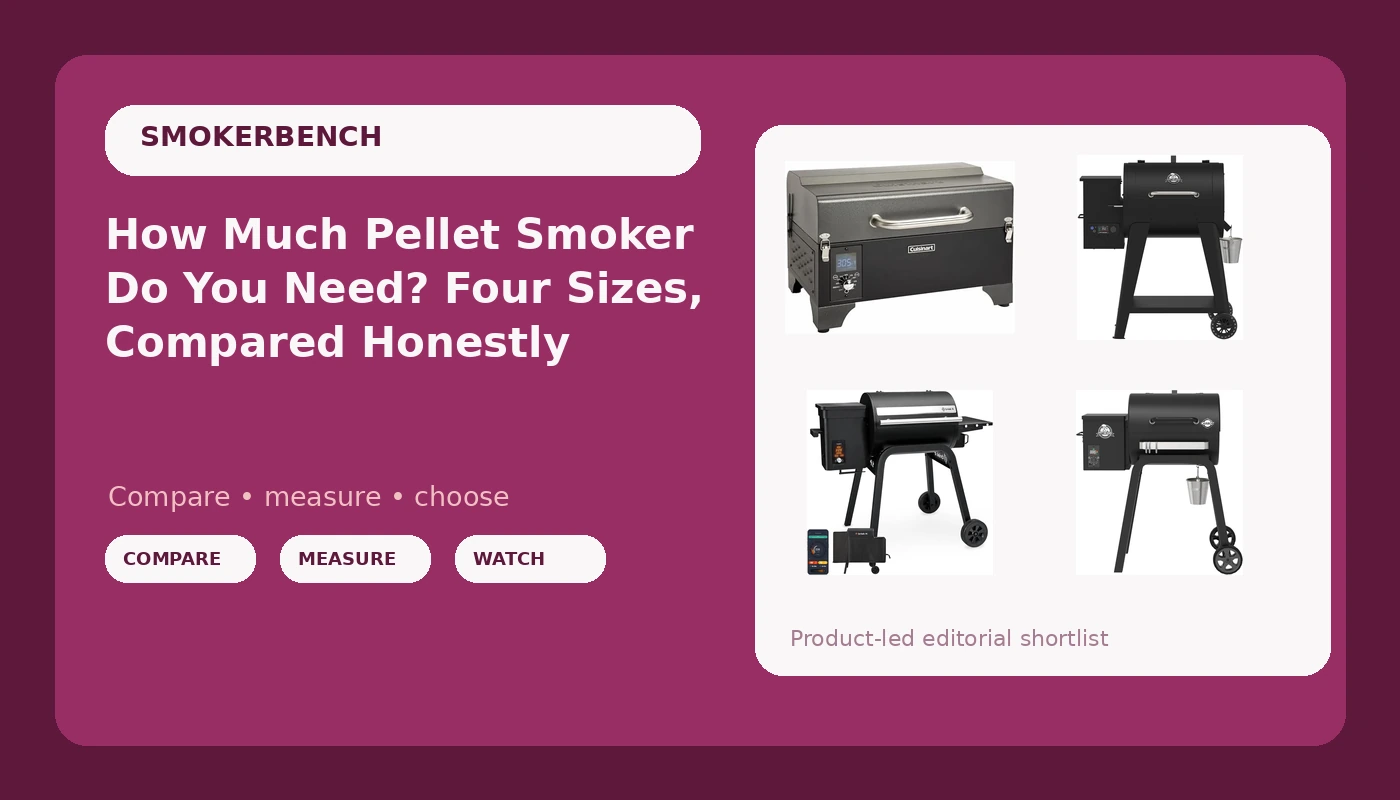
Walk the pellet aisle or scroll the listings and every box says the same thing: a digital controller, a wide temperature range, a hopper, a meat probe. The category has converged on the spec sheet, which means the spec sheet stopped telling you much. The questions that actually decide whether a wood pellet grill and smoker earns its footprint are smaller and more specific: how much food has to fit at once, how long the hopper lasts on a long cook, and whether the controller holds a set temperature when the weather stops cooperating. Get those three right and you stop shopping for features and start shopping for the size of your cook.
Related: Pellet Grill Temperature Swings: Reading a Cook Log →
Quick answer
Match the cooker to your largest regular cook, not to your largest imagined one. A 747 square inch grill with a 21 lb hopper covers a full packer brisket plus sides for a crowd. A 543 square inch grill with a 13.5 lb hopper covers the same cook with less room to spread out and more refills. A 450 square inch WiFi unit covers weeknight ribs, chicken, and smaller gatherings. A compact 8-in-1 portable covers tailgates, RV kitchens, and campsites where the grill has to travel. Everything else is garnish.
Four useful options
| Model | Best fit | What stands out |
|---|---|---|
| Pit Boss 700 FB2 Series Wood Pellet Grill & Smoker | Large-batch backyard cooks | 747 sq. in. of cooking space, 21 lb hopper, flame broiler |
| Pit Boss 500 Carbon Series Wood Pellet Grill & Smoker | Smaller patios and tighter budgets | 543 sq. in. of cooking space, 13.5 lb hopper, LCD controller |
| Brisk It Zelos-450 Wood Pellet Grill & Smoker | Cooks who want connectivity built in | 450 sq. in. of cooking space, WiFi and A.I. features |
| Cuisinart 8-in-1 Portable Wood Pellet Grill and Smoker | RV, tailgate, and camping duty | Compact 8-in-1 design built to move |
Largest cooking space: Pit Boss 700 FB2 Series Wood Pellet Grill & Smoker
Square inches are the number people brag about and the number they regret ignoring. A brisket takes up a lot of grate, and once you add a water pan, a couple of racks of ribs, or a tray of beans, a mid-size cooker starts feeling like a game of Tetris at hour one. The 747 square inch grate on this one is the practical answer to that. The 21 lb hopper matters for the same reason: the longer a cook runs, the more pellets the auger feeds, and every pound of hopper capacity is time you are not standing in the dark with a pellet scoop. The flame broiler is the part that separates it from a pure smoker, since it lets you slide the plate and finish over direct heat.
Smaller footprint, same temperature range: Pit Boss 500 Carbon Series Wood Pellet Grill & Smoker
The trade here is straightforward and worth stating plainly: 543 square inches is plenty for two racks of ribs, a spatchcocked chicken, or a pork butt, and it will still hold a brisket with less room for anything else. The 13.5 lb hopper is the number I would think hardest about. It is a real hopper, not a camping hopper, but on an overnight cook it means one more refill window than the larger Pit Boss above. If you cook long and slow on a schedule, plan that into your night. If most of your cooks finish in four to six hours, the smaller hopper is a non-issue and the smaller grate is a feature, since less steel to heat means the grill gets where you want it without burning through pellets to get there.
Connected cooking: Brisk It Zelos-450 Wood Pellet Grill & Smoker
I have made my peace with apps, and my peace looks like this: a phone is a convenience, not a feature, and I judge the cook, not the notification. That said, a connected controller is genuinely useful for one thing, which is seeing a temperature trend without walking outside. A graph on your phone at 11 PM tells you whether the pit is holding or drifting, and that is information, not entertainment. The catch is the connection itself. If your WiFi drops at the far end of the yard, the app is only as good as your router, and you should treat the A.I. features as a helper rather than a replacement for knowing what your cook looks like. At 450 square inches, this is also the smallest grate of the three full-size options, so go in clear-eyed about batch size.
Portable: Cuisinart 8-in-1 Portable Wood Pellet Grill and Smoker
A portable pellet cooker solves a problem the full-size grills cannot touch, and it creates one they do not have. The problem it solves is real: an RV trip, a stadium lot, a campsite, or a small balcony where a 500 series grill is simply not an option, and where you still want smoke rather than a gas grate. The problem it creates is capacity. Compact means small, so this is a chicken, a rack of ribs, or a few steaks at a time, not a packer brisket for twelve. The 8-in-1 framing is worth reading closely for whatever functions you actually plan to use, because versatility in a small box is a list of modes, not extra grate area. Buy it as a second cooker or a travel cooker and it makes sense. Buy it as your only grill for a family of six and you will run out of room.
Prices and availability may change. Product images, names, and retailer links are matched to verified listings. No current price, rating, stock status, or measured result is stated here without current evidence.
What actually decides a cook: firepot, steel, and the controller
Every pellet grill in this group advertises 180°F to 500°F, which is the standard range for the category and tells you almost nothing on its own. The range is a capability statement, not a stability statement. What you want to know is what happens between 225°F and 275°F, because that is where brisket, pork shoulder, and ribs live, and it is where a weak controller shows itself. A pit that runs hot and then overshoots on the recovery, or one that sags every time the auger cycles, produces a cook that finishes unevenly no matter how good your rub is. Temperature stability is the whole game.
The physical parts behind that stability are the firepot and the steel around it. The firepot is where the auger drops pellets, and it is the part that takes the most heat cycling and the most moisture. Thin steel there warps, and a warped firepot changes how the flame sits under your grate. When you are comparing listings, look for how the firepot is described and how accessible it is for cleaning. Ash buildup in the firepot is the root of a lot of complaints that get blamed on pellets or on the controller. The same logic applies to the body of the grill: heavier steel holds temperature better in wind and cold, which matters a great deal if you cook through a Kansas October or a January.
Controller design is the third leg. A digital controller with a meat probe gives you two pieces of information instead of one, the pit temperature and the internal temperature of the meat, and that pairing is what lets you decide when to wrap and when to pull. It does not make the decision for you, and no controller replaces a habit of checking the pit. The cook is still yours.
Sizing the cook: square inches, hopper pounds, and the 2 AM question
Two numbers separate these four grills more than any feature list: grate area and hopper capacity. Grate area decides what fits at once. Hopper capacity decides how long you can walk away. Both are simple, and both get underestimated at the register.
Rough sizing logic works well here. A brisket with room to breathe takes a large share of a mid-size grate. Two racks of ribs plus a chicken fit comfortably in the 500 square inch class. A 450 square inch grate handles a family cook but not a party cook. And a portable unit handles a meal, not an event.
Hopper capacity is the quiet spec. Pellet consumption rises with temperature and with outside conditions, so a long cook at 250°F in cold wind draws more from the hopper than the same cook on a mild afternoon. A 21 lb hopper and a 13.5 lb hopper are both usable, but they produce different nights. The larger hopper gives you a longer stretch before you have to top off, which matters most at exactly the hour you would rather be asleep.
A short decision sequence that keeps you out of the wrong purchase:
- Write down your largest regular cook, not your biggest fantasy cook, including sides.
- Convert that into grate area and compare it to 450, 543, and 747 square inches.
- Estimate the longest single cook you do per year and match hopper size to it.
- Decide whether connectivity changes your behavior or just your phone habits.
- Decide whether the grill has to move, because that answer eliminates most of the field immediately.
Practical guidance before you order
- Budget for pellets as a recurring cost, not a one-time purchase, since long cooks consume real volume.
- Store pellets sealed and dry. Humidity turns pellets to dust, and dust is what jams an auger.
- Plan a firepot cleaning routine from week one, because ash is the enemy of a steady flame.
- Check the hopper lid seal against rain if the grill lives outside, since a wet hopper is a ruined cook.
- Buy a thermometer you trust for the grate, because a controller reading and the actual grate temperature are not always the same conversation.
- Think about wind. A patio corner that funnels wind will make any controller work harder than it should.
Which option should you choose?
Choose the Pit Boss 700 FB2 Series Wood Pellet Grill & Smoker when your regular cook is a large one and you want the most grate area and the longest stretch between hopper refills in this group. Choose the Pit Boss 500 Carbon Series Wood Pellet Grill & Smoker when you want the same temperature range and controller style in a smaller footprint and can live with a smaller grate and a 13.5 lb hopper. Choose the Brisk It Zelos-450 Wood Pellet Grill & Smoker when a connected controller and A.I. features are part of what you want from a grill and a 450 square inch grate covers your typical cook. Choose the Cuisinart 8-in-1 Portable Wood Pellet Grill and Smoker when the grill has to travel or fit a small space, and you are cooking for a few rather than a crowd.
One caveat worth carrying into the decision: the specifications above describe what each grill is built to do, and they are not a substitute for how a specific unit performs on your patio, in your weather, with your pellets. Temperature behavior, ash handling, and auger reliability show up over dozens of cooks, not in a product listing. Read the current owner feedback on the listing you are considering, and weigh it against your own cook schedule rather than against a marketing claim.
The bottom line
The pellet grill market has settled into a narrow band of features, so the decision comes down to size and stability. Grate area decides whether your brisket fits with room to spare. Hopper capacity decides whether you are refilling at 2 AM. Controller and firepot design decide whether the pit holds where you set it while you sleep. Pick the grill whose numbers match the cooks you actually make, keep the firepot clean, keep the pellets dry, and let the temperature log tell you the truth about your rig.