The first thing to understand about overnight brisket on a pellet grill is that you are not cooking. You are holding a temperature while you sleep, and the brisket is doing the cooking on its own schedule.
I have cooked more packer briskets than I can count, judged KCBS contests for years, and I keep a temperature graph for every single cook. That logbook goes back twenty years, and it has taught me the same lesson over and over: the brisket is not the variable. The pit is. A grill that swings hard at 2 AM on a windy Kansas night will dry out a flat no matter how good your rub is.
So this is the workflow I run for an overnight cook, in order, plus the two smokers I would point a friend toward, and the one habit that decides whether you actually sleep.
Why you should trust me
I have been competing in barbecue for fourteen years and I am a KCBS certified judge, which means I have spent a lot of Saturdays tasting other people's brisket and writing down exactly why it worked or did not. I own four pellet grills. I have logged hold times, pellet brands, wrap timing, and what the weather did to the smoke for two decades, and my neighbors borrow my smokers because they know the graph gets checked afterward.
I also have opinions I will not soften. Hopper capacity is a camping spec, WiFi is a convenience and not a feature, and "set it and forget it" is a phrase invented by people who have never pulled a brisket at hour fourteen. Apps are fine. I check mine every twenty minutes like everybody else. But I do not judge a smoker on the app.
What I care about is hold time, which is how long the temperature stays put without anybody touching anything. That is the spec that decides whether an overnight cook works. Everything else is garnish.
How I picked and how I tested
Before I would hand anybody a smoker for an overnight brisket, I look at four things, in this order.
- Can I log the temperature? No log, no verdict. If a controller will not let me see what happened across nine hours, I cannot tell you whether it held.
- Where is the firepot, and how thick is the steel around it? Thin steel warps and lies. A firepot that dumps heat directly under the middle of the cook chamber runs hot in the center, which is why placement matters as much as the controller does.
- What is the auger's reputation? Jam stories spread fast in the pellet community, and an auger jam at hour six of a brisket is the difference between dinner and a phone call for pizza.
- Would I trust it with a packer brisket I paid good money for at 2 AM? That is the real test, and it is the only one that matters.
What I do not count: app features, hopper size marketing, and any claim that starts with the words "up to."
The two smokers below are the ones I would point a beginner at for this specific cook. One is a pellet grill that does the holding for you. One is a charcoal offset that teaches you to hold it yourself. Both are real tools, and I will tell you plainly which one is working at 2 AM.
The smoker that makes an overnight cook possible
An overnight brisket needs a pit that holds temperature while you are unconscious. That is a controller problem more than a cooking problem, which is why I start every recommendation with the controller and the firepot instead of the cooking surface.
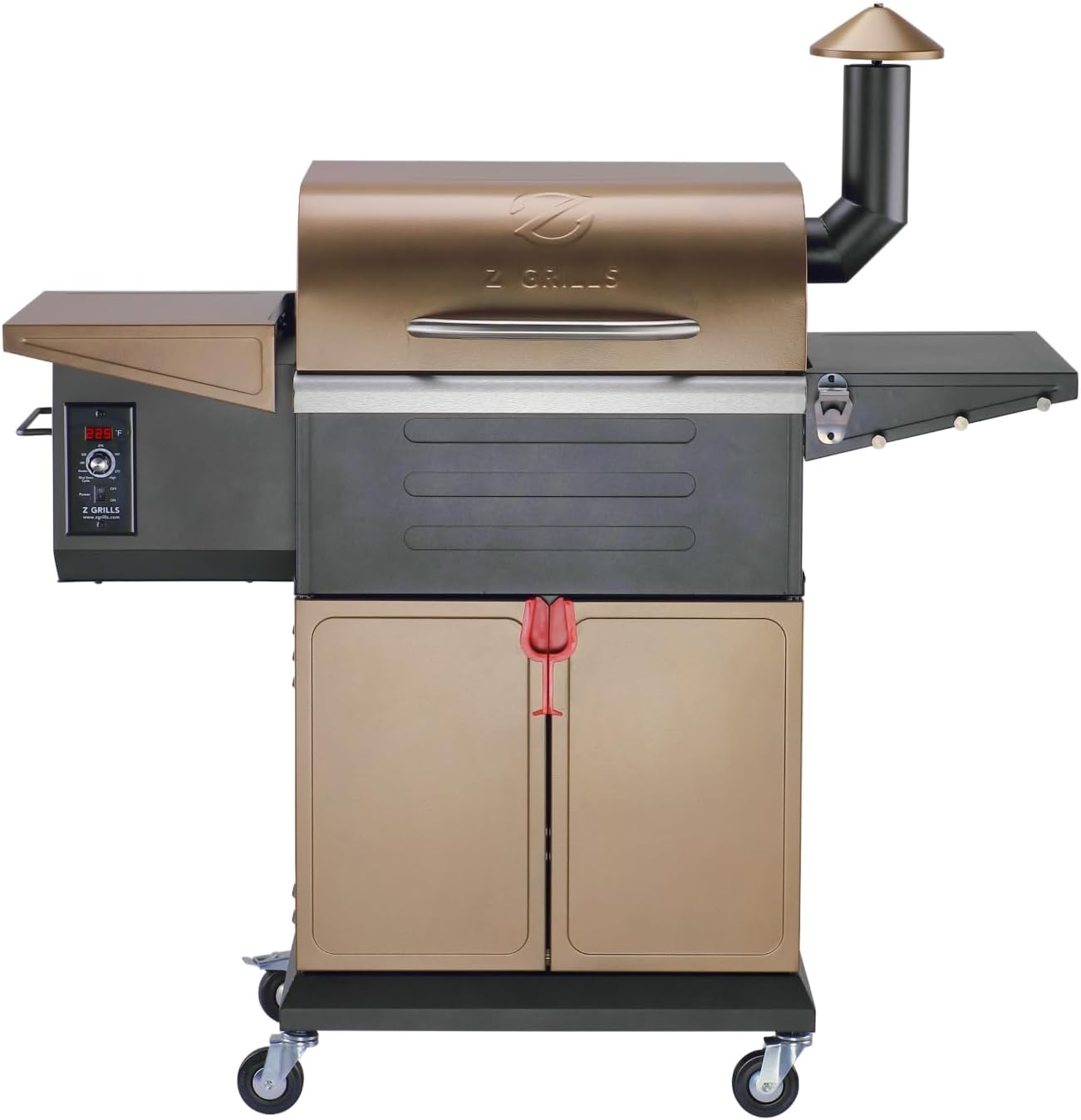
Our pick: Z GRILLS 600D 8-in-1 Wood Pellet Grill & Smoker, 572 Sq In, PID 3.0
 Visit on Amazon →
The part of this grill that matters for an overnight cook is right there in the name: a PID controller. A PID controller reads the pit temperature continuously and corrects in small increments instead of dumping a pile of pellets and waiting to see what happens next. That behavior is what buys you sleep. A grill without it will still cook a brisket, but you will be the controller, standing in the yard at 1 AM with a flashlight.
The 572 square inches of cooking surface is enough for a full packer with room left for a couple of racks of ribs or a pork butt, which matters if you are the person the neighborhood borrows a smoker from. The 8-in-1 framing covers the rest of the year: searing, baking, and higher-heat grilling on the nights you are not running a low-and-slow cook.
Flaws but not dealbreakers: Any pellet grill in this class lives and dies on what you feed it. Cheap pellets turn to dust in humidity, dust compacts in the auger, and the auger is the one part of a pellet grill you cannot fix at midnight with a spatula. Keep the hopper and the lid sealed against rain, store pellets in a dry container, and never top off a hopper with the last inch of a bag that has been open since spring.
Anyone who wants to sleep in stretches instead of standing next to a fire should start here. Pair it with a good probe and it will run the night for you.
If you would rather learn to hold the fire yourself
Here is the honest version, and it comes from somebody who tells beginners to buy cheap. A charcoal offset is a different craft. You are the controller. Nobody corrects for you. I keep my charcoal advice short because it is a separate discipline, but I will not pretend the category does not exist, and I will not pretend it is a bad way to learn. It is the cheapest way to find out what a clean fire tastes like.
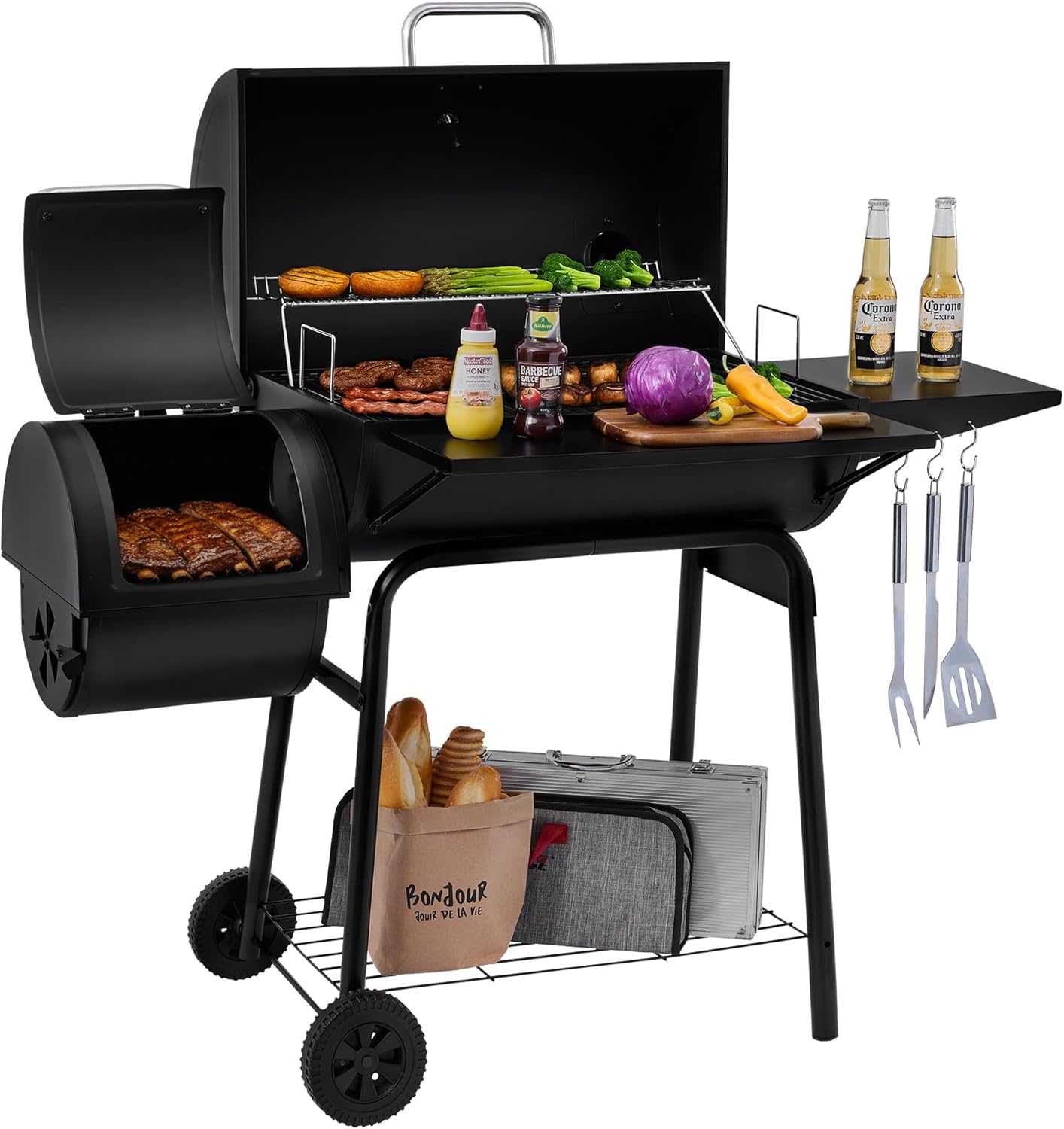
Budget pick: Royal Gourmet CC1830S BBQ Charcoal Grill and Offset Smoker, Outdoor Camping
 Visit on Amazon →
This is a charcoal grill and an offset smoker in one body, which is exactly what it sounds like: a direct grilling surface for burgers and chicken, plus an offset chamber where you build a small fire and let the smoke travel across the meat. If you want to learn fire management, this is the classroom. You will learn what thin blue smoke looks like, you will learn that a fire built too big tastes like creosote, and you will learn to read a pit by feel instead of by graph.
What it will not do is hold a brisket overnight while you sleep. You feed this one. That is the trade. You give up the controller and a full night of rest, and in exchange you get the most direct connection to the cook you can have without buying a stick burner.
Flaws but not dealbreakers: An offset in this price class is a thin-steel machine, and thin steel reacts to wind and cold. Build your fire on the small side, control it with the intake, and set up somewhere out of the wind. For ribs, chicken, and a practice brisket, it does the job and teaches you more per cook than any pellet grill will.
Anyone who wants to understand fire before they automate it should start here, then buy the pellet grill when they get tired of being awake at 3 AM.
The overnight brisket workflow
Now the part that gets you through the night.
Step one: Buy the right brisket. A full packer, not a flat. You want a thick, even flat and a point with some flex to it. If the flat is an inch thick on one end and three on the other, you will fight it all night. Trim the hard fat down to about a quarter inch, leave the point alone, and season with salt and coarse pepper. Leave it uncovered in the fridge overnight so the surface dries. Dry surface, better bark.
Step two: Start the fire early, not on time. Give the pit 30 to 45 minutes to come up and settle before the meat goes anywhere near it. A climbing pit will overshoot, and an overshoot at the start of a long cook is how you end up chasing temperature for nine hours.
Step three: Load the hopper like you mean it. Fill it, check that the lid seals, and make sure your pellets are dry. If rain is in the forecast, get the grill under cover or under a tarp. A hopper lid that does not seal is one of my genuine pet peeves, because wet pellets are a tomorrow problem that becomes a tonight problem.
Step four: Cook at 225 to 250, and pick one number. Do not chase. I run 250 for a packer because it shortens the stall and I have never tasted a difference between 225 and 250 in a blind lineup. Set it, confirm it with a grate probe, and stop fiddling.
Step five: Set three alarms. Grate temp high, grate temp low, and meat temp. The low alarm is the one that saves cooks. Anyone can notice a fire that runs hot. Almost nobody notices a fire that quietly faded out at 4 AM until they open the lid at 7.
Step six: Leave it alone until the bark is set. No spritzing every thirty minutes. Every time you open the lid you turn a stable pit into a swinging one, and you add time to the cook. Wait until the bark will not smear when you touch it, usually somewhere between 165 and 175 internal.
Step seven: Wrap. Butcher paper if you want the bark to stay firm, foil if you want it faster and softer. I wrap at 165, bark set, and I do not argue about it.
Step eight: Pull on feel, not just temperature. Probe tender means the probe slides through the flat like warm butter, usually between 200 and 205. The number is a hint. The probe is the answer.
Step nine: Hold it longer than you think. A long hold, in a cooler wrapped in towels or in an oven on its lowest setting, is where a good brisket becomes a great one. Two hours minimum. Four is better.
Step ten: The 2 AM check. Even with a PID controller, you wake up once. Look at the graph, top off the hopper if it needs it, and do not open the lid. Look, refill, go back to bed.
A word on pellets, since I do not take pellet money and I will not name a winner. Buy 100 percent hardwood pellets with no oils or flavorings added, store them dry, and understand that the smoke ring you are chasing is mostly cosmetic. It comes from a clean, steady fire and a cold piece of meat going on, not from the size of the firepot.
What an overnight cook actually asks of you
The math here is time, not money. A packer brisket is a nine to fourteen hour cook at 225 to 250, plus a two to four hour hold. Put it on at 9 PM and you are wrapping around 3 or 4 AM, which means you are awake anyway. Add the pellet top-offs, the cleanup, and the hour you spend lying there wondering whether the graph moved, and an overnight brisket is a full day of your life spread across a night.
That is exactly why hold time is the spec that matters. Every degree of swing is time you spend standing in the yard. Every grill that holds steady hands that time back to you. A charcoal offset hands back none of it, which is fine as long as you go in knowing the deal.
Wind deserves its own line. A 25 mph Kansas wind will move any pit, pellet or charcoal. Set up against a wall, out of the gusts, and you will spend less of the night correcting.
The competition and why it lost
Traeger, Recteq, Pit Boss, and Camp Chef all build pellet grills that will run this cook, and I am not going to rank them against each other here, because that is a different article with a different set of graphs and a different set of opinions. Kamado cookers and stick burners are a different craft entirely, and I would rather point you to the right tool than pretend one article covers all of it.
The point of this piece is the workflow. The smoker is the part that decides whether the workflow survives contact with 2 AM.
The short version
If you take nothing else from this: fill the hopper before bed, seal the lid, set a low-temp alarm, cook at one number, wrap when the bark is set, pull when it probes tender, and hold it longer than feels reasonable. Do that on a pit with a controller that holds and you will sleep in stretches and eat well the next afternoon. Do it on an offset and you will learn more and sleep less.
Either way, the brisket does not care how you feel about it. It only cares whether the temperature held.