Most people shopping for a smoker pour every hour of research into the cabinet and almost none into the smoker setup essentials around it. Then the first long cook arrives, the wind shifts, the rain starts, and the gaps show up: nowhere dry to plug in, no cover, no plan for the pile of onions that goes with a pulled pork feed. This is an explainer rather than a shootout. Four products, four jobs, and an honest accounting of what each one does, what it does not do, and who should care.
Related: Pellet Grill Temperature Swings: What the Log Actually Shows →
Quick answer
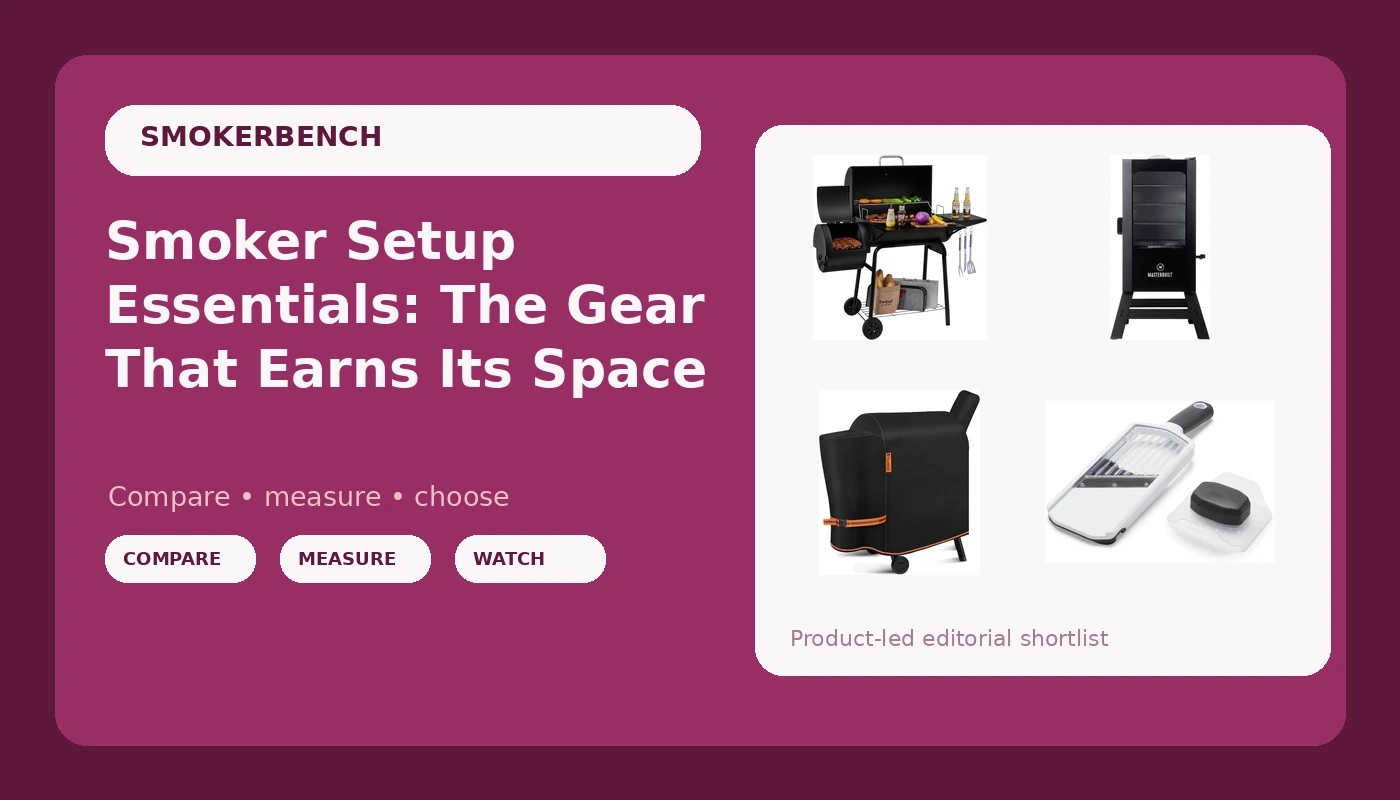
The right smoker setup depends on how much attention you want to give a cook. An electric vertical cabinet such as the Masterbuilt 30-inch is the low-attention option, with a digital controller, a side chip loader, and 710 square inches of cooking space in a small footprint. A charcoal offset such as the Royal Gourmet CC1830S is the high-attention option, with live fire and two zones to manage. A fitted 1000D cover protects a Traeger Pro 22 or Pro 575 between cooks, and a handheld mandoline handles the slicing work that shows up when you are feeding more than four people. Match the tool to the job and none of these purchases is wasted.
Four useful options
| Model | Best fit | What stands out |
|---|---|---|
| Masterbuilt® 30-inch Digital Electric Vertical BBQ Smoker with Leg Kit, Side Wood Chip Loader and 710 Cooking Square Inches in Black, Model MB20070421 | Overnight and weekday cooks where the machine holds the temperature | Digital electric vertical cabinet, 710 square inches of cooking space, side wood chip loader, leg kit included |
| Royal Gourmet CC1830S BBQ Charcoal Grill and Offset Smoker, Outdoor Camping | Cooks who want charcoal and a fire to steer | Charcoal grill with a separate offset smoking chamber |
| 1000D Heavy Duty Grill Cover for Traeger Pro 22/575 Series BAC503 | Keeping a Traeger Pro 22 or Pro 575 dry between cooks | 1000D fabric, cut for the Pro 22 and Pro 575 series |
| Cuisinart PrecisionSlice™ Handheld Mandoline Slicer | Prep work: onions, potatoes, cucumbers, cabbage | Handheld mandoline built for thin, even slices |
The overnight cabinet: Masterbuilt® 30-inch Digital Electric Vertical BBQ Smoker with Leg Kit, Side Wood Chip Loader and 710 Cooking Square Inches in Black, Model MB20070421
The case for an electric vertical cabinet is simple: the controller holds the temperature and you do not feed a fire. That is the whole appeal for an overnight pork butt or a rack of ribs while you do something else with your evening. The trade-offs are real, though. Electric means an outlet and a dry place to use it, and a chip loader means you are adding wood chips by hand rather than filling a hopper once and walking away. The vertical shape is a bonus if you cook for two or three people, because the footprint is small and the heat rises through the cabinet rather than spreading sideways. If you want smoke to come from a long, steady smolder without babysitting a fire, this is the shape that gets you there.
The live fire: Royal Gourmet CC1830S BBQ Charcoal Grill and Offset Smoker, Outdoor Camping
My honest position: I do not run charcoal offsets, and that is a different craft from the electric and pellet cooking I write about. I am including the Royal Gourmet CC1830S because readers ask about this category constantly, and it deserves a straight description rather than a dismissal. An offset splits the job in two. You get a coal bed for direct grilling and a separate chamber where heat and smoke travel across the food before it exits the stack. That design asks something of you. You build the fire, you feed it, and you learn the habits of your particular cooker over several sessions. The reward is live fire and the kind of bark that comes from a real coal bed. If you want to be involved in every hour of a cook, this is the tool for that. If you want to sleep, look above.
The cover: 1000D Heavy Duty Grill Cover for Traeger Pro 22/575 Series BAC503
A cover is the least glamorous purchase in this article and the one that most often gets skipped. The 1000D Heavy Duty Grill Cover is cut for the Traeger Pro 22 and Pro 575 series, which makes it a fitted cover rather than a universal tarp, and 1000D denotes a heavy denier fabric, which is the spec you want in something that sits outside year round. The caveat is right there in the name. If your grill is not a Pro 22 or Pro 575, measure before you buy, because a loose cover flaps in the wind and a tight one pulls at the seams. What a cover buys you is boring and important: no water sitting on a controller, no damp fuel, no rust working on the lid while the grill waits for the weekend.
The prep tool: Cuisinart PrecisionSlice™ Handheld Mandoline Slicer
The Cuisinart PrecisionSlice is not a smoker part, and I am not going to pretend it is. It is a handheld mandoline for the prep that surrounds a cook: onions for a batch of sauce, potatoes for a side dish, cucumbers for pickles, cabbage for slaw. A handheld tool trades capacity for storage, which suits a kitchen that already has a smoker competing for room. If you have ever sliced onions for twenty people with a chef's knife, you know exactly what problem this solves. Check the listing for the thickness settings and the hand guard before you commit, and treat the blade with respect, because mandolines are sharp by design and that is the point of owning one.
Prices and availability may change. Product images, names, and retailer links are matched to verified listings. No current price, rating, stock status, or measured result is stated here without current evidence.
What actually matters in a smoker setup
Temperature stability decides whether a long cook works, and temperature stability is a system property rather than a single line on a box. The cooker, the fuel, the wind, and how often you open the lid all feed into it. A controller that holds a number for six hours is worth more than a larger cooking chamber, because a larger chamber that swings is just a larger problem. The practical setup questions are narrow: where does the heat come from, what keeps it steady, what protects the machine between cooks, and what happens to the food after it comes off. Everything in this article maps to one of those four questions.
Hold time is the number I care about, and it is not printed on any box. It is how long a cooker stays inside a useful range without you touching anything. You build hold time with a sheltered spot, a full fuel supply, and a lid that stays shut. A cover contributes in a small way by keeping moisture out of the controller and the fuel. A slicer contributes in a small way by getting the finishing work done fast so the meat rests instead of waiting on you. Neither is the headline purchase, and both are the difference between a setup that works on a Tuesday night and one that only works on a sunny Saturday.
Electric, charcoal, or pellet: how much attention do you want to give?
Fuel choice is really an attention choice. Electric cabinets run on a controller and an element, which means the machine holds the temperature and you hold the schedule. Charcoal offsets run on a fire you build and feed, which means the cook is a conversation and you are in it for the full six hours. Pellet grills sit in the middle, with an auger feeding fuel on a controller's command, which is why they show up in so many backyards and so many arguments.
None of these is a moral position. Someone who works nights and wants brisket on Sunday is not served by a fire that needs feeding at 3 AM. Someone who wants to learn live fire is not served by an element. The mistake is buying the wrong tool for the hours you actually have, then blaming the food.
The setup around the cooker changes with the fuel, too. Electric needs an outlet and a dry place to sit. Charcoal needs fuel storage, a chimney, and somewhere to dump ash. Pellet needs dry pellets and a clean firepot. Plan for the supporting cast at the same time you plan for the cooker, because the supporting cast is what fails first.
How to choose in five steps
- Decide how many hours you want to be involved. A short rib cook and a long brisket ask for different machines, and the answer changes with your schedule, not your ego.
- Check the site before the specs. Outlet, level ground, shelter from the prevailing wind, and enough clearance to open the lid without hitting a fence.
- Pick the fuel, then the cabinet. Electric for hands-off cooking, charcoal for hands-on cooking, and be honest about which one you will still use in February.
- Measure before you buy a cover. A fitted cover for the Pro 22 and Pro 575 series is only fitted if you own one of those grills.
- Plan the finish. Resting, slicing, and serving all happen after the cook, and prep tools earn their keep in that window.
Practical notes before you buy
- Buy the cover with the grill rather than two seasons later, when the controller has already seen rain.
- Keep the smoker out of the worst of the wind. Shelter buys you hold time that no controller setting can.
- Store fuel dry and off the ground. Damp fuel is the shortest path to a stalled cook.
- Check the fit and the model number on any cover listing against your own grill before ordering.
- Wash and dry a mandoline immediately after use, and keep the guard where you can find it.
Which option should you choose?
Choose the Masterbuilt® 30-inch Digital Electric Vertical BBQ Smoker with Leg Kit, Side Wood Chip Loader and 710 Cooking Square Inches in Black, Model MB20070421 when you want the cooker to hold temperature while you sleep, and when you have power and shelter at the cooking site. Choose the Royal Gourmet CC1830S BBQ Charcoal Grill and Offset Smoker, Outdoor Camping when you want a live fire, two zones, and a cook you steer from start to finish. Choose the 1000D Heavy Duty Grill Cover for Traeger Pro 22/575 Series BAC503 when you own a Traeger Pro 22 or Pro 575 and want it dry between cooks. Choose the Cuisinart PrecisionSlice™ Handheld Mandoline Slicer when the prep, not the smoke, is your bottleneck on cook day.
One caveat worth stating plainly: nothing here is a claim about measured performance. These are descriptions of what each product is and the job it is built for, based on the listings. The numbers that matter most, including hold time, fuel burn, and how a cover's seams survive a winter, are things you learn over a season of your own cooking rather than from a spec sheet.
The bottom line
A smoker is one purchase, and a working smoker setup is three or four. Pick the fuel that matches the hours you actually have, protect the machine you bought, and give yourself a fast way to handle the prep that shows up around every long cook. Do that and the gear stops being the story. The cook is the story, and the gear just stays out of its way.