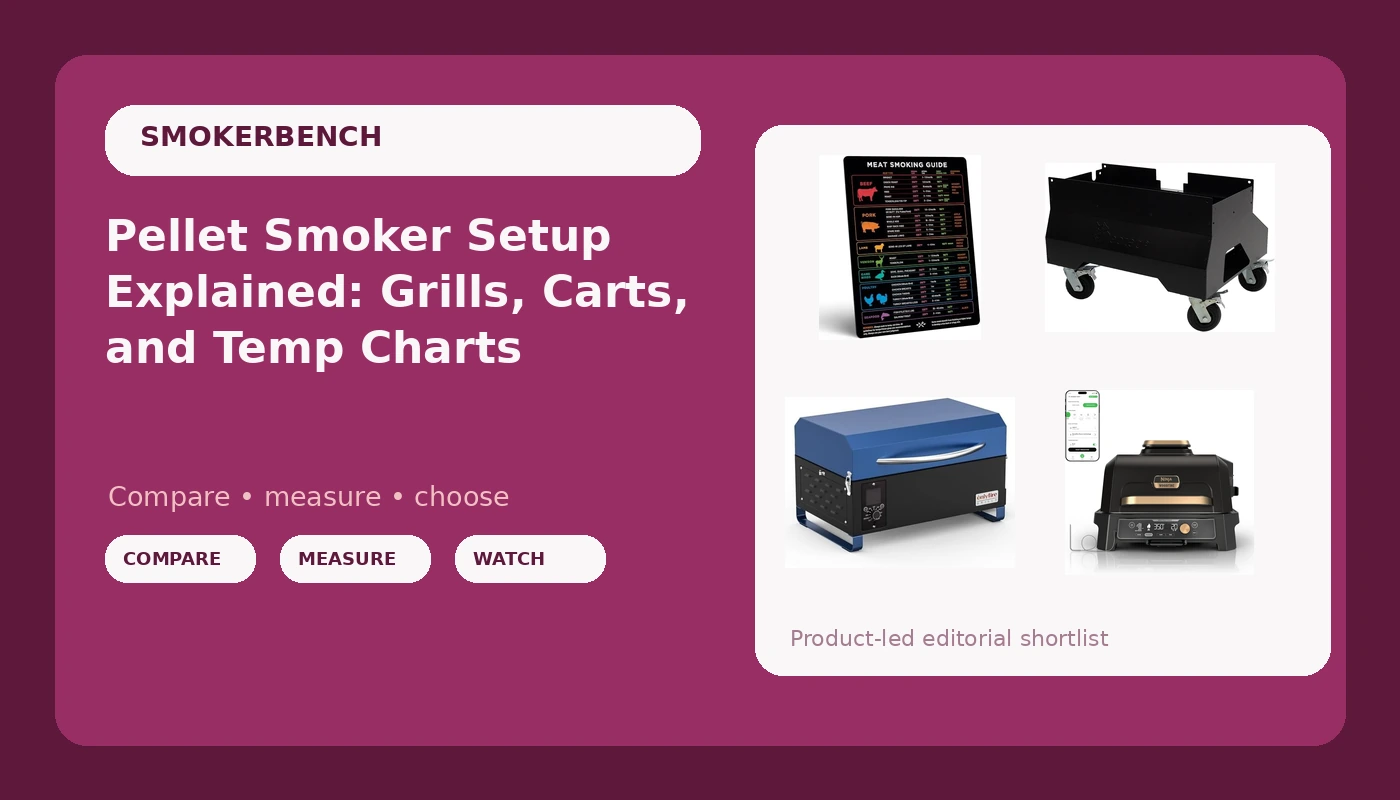
Most shoppers treat a pellet smoker as a single purchase. It is really a pellet smoker setup: the grill itself, whatever it stands on, the fuel you feed it, and the reference you trust at 2 AM when the stall hits and you are half asleep. I have judged enough KCBS contests and kept enough temperature logs to know the grill is only part of the story. The rest is hold time, wind, and whether you can check a target temperature without lifting the lid and dumping heat. This guide walks through four pieces that cover that setup, from a countertop style outdoor pellet grill to a full size rig, a competition cart built for one specific grill, and a magnet chart that costs less than a brisket.
Related: Pellet Grill Temperature Swings: What a Log Actually Tells You →
Quick answer
There is no single best pellet smoker, because the right machine depends on the largest cook you actually do and where the grill lives. A countertop style outdoor pellet grill suits small patios, quick cooks, and anyone who wants app monitoring in the product itself. A full size pellet grill suits long brisket and pork shoulder cooks that run overnight. A competition cart matters only if you already own the grill it was built for. A temperature magnet is the cheapest piece of the setup and the one that changes how often you open the lid.
Four useful options
| Model | Best fit | What stands out |
|---|---|---|
| Ninja Woodfire ProConnect Premium XL Outdoor Grill & Smoker, Black & Gold | Small patios, quick cooks, app monitoring | Outdoor grill and smoker in one unit with ProConnect connectivity named in the product line |
| ONLYFIRE GRILLS BBQ Wood Pellet Grill Smoker, Blue GS313 | A dedicated pellet grill in a blue finish | Listed as a pellet grill and smoker in a single unit |
| recteq RT-590 Wood Pellet Grill Competition Cart with Caster Wheels | Owners of the RT-590 who want the grill off a table | A cart built specifically for the RT-590, with caster wheels |
| Meat Temperature & BBQ Smoker Guide Magnet - Wood, Time & Temp Chart | Anyone who wants target temps within arm's reach | Wood, time, and temp chart in a magnetic format |
The all-rounder: Ninja Woodfire ProConnect Premium XL Outdoor Grill & Smoker, Black & Gold
The trade-off with this class of machine is capacity versus footprint. A grill built around patio use and a connected app tends to have a smaller grate area and a smaller hopper than a full size pellet rig, which matters when a packer brisket and two pork shoulders need to share space. The counterweight is convenience: less fuel to load, less steel to heat, and a shorter path from deciding to cook to actually cooking. If your cooks are ribs, chicken, and the occasional small brisket, this is the shape of grill that fits the life you actually live. If you routinely feed a crowd, read the next entry.
The dedicated pellet rig: ONLYFIRE GRILLS BBQ Wood Pellet Grill Smoker, Blue GS313
With any pellet grill in this class, the details that decide your satisfaction are the ones you cannot see in a photo. Ask where the firepot sits and how thick the steel around it is, because thin steel warps and a warped firepot lies to you about temperature. Ask about the auger's reputation, since jam stories spread through this community faster than any spec sheet. And look at hopper capacity honestly: a small hopper means you are refilling at 2 AM, and a hopper lid that does not seal against rain means your pellets drink humidity and turn to dust. None of that is glamorous, and all of it is the difference between sleeping and babysitting.
The upgrade path: recteq RT-590 Wood Pellet Grill Competition Cart with Caster Wheels
Buying this without owning the grill it fits is the most common mistake in this category. A cart is a fitment purchase first and a feature purchase second, so confirm the model before you order. The payoff is real, though: a grill sitting on a folding table is a grill you bend over all afternoon, and casters turn a two person shuffle into a one person roll. On a flat patio or a level trailer floor, casters behave; on gravel or a slope, they remind you that wheels only work as well as the surface under them. Pair it with a grill you already trust and a log you already keep, and the cart is the least interesting upgrade that improves every cook.
The reference piece: Meat Temperature & BBQ Smoker Guide Magnet - Wood, Time & Temp Chart
A chart does not cook anything. What it does is cut down the number of times you lift the lid to check a number you should already know, and every lid lift costs you heat and time. It also settles arguments at the table about whether the chicken is done, which is worth more than the magnet costs. Where it goes matters: on the lid, on the side shelf, or on the fridge in the garage where you prep. Pair it with an instant read thermometer, because a chart tells you the target and only a probe tells you where you actually are.
Prices and availability may change. Product images, names, and retailer links are matched to verified listings. No current price, rating, stock status, or measured result is stated here without current evidence.
What actually holds temperature in a pellet grill
Temperature stability is the whole game. A pellet grill that swings widely is a campfire with a hopper, no matter how good the paint looks. Four things drive stability, and only one of them is on the marketing sheet.
The controller is the first. A controller reads the temperature probe and decides how often to run the auger. Controllers that react quickly and gently hold a tighter band than controllers that wait for a big drop and then dump fuel to catch up, which is how you get overshoot and a see-saw graph.
The firepot is the second, and the most underrated. The firepot is where the auger drops pellets, and it is also where heat, ash, and moisture all meet. Thicker steel holds up to that environment longer. Thin steel warps, and a warped pot changes the airflow around the fire, which changes the burn, which changes your temperature. Ash buildup does the same thing slowly, which is why a vacuum before a long cook is not optional.
Fuel is the third. Pellet quality and moisture content drive both smoke flavor and heat output. Pellets that have absorbed humidity from a lid that does not seal burn differently than dry pellets from a fresh bag, and the difference shows up as a wider swing and more ash. Buy pellets from a source with fast turnover, store them sealed and dry, and do not mix a half bag of unknowns into a brisket cook.
Weather is the fourth, and the one nobody budgets for. Wind strips heat off the lid and the controller compensates by feeding more pellets, which is fine until the wind gusts and the graph turns into a staircase. On a 25 mph Kansas day, a welder's blanket over the cooking chamber is not a gimmick, it is data management.
How to read a temperature log
A log is how you turn a cook into knowledge instead of a story. The point is not to prove anything to anyone. The point is that when a brisket stalls or a pork shoulder finishes early, you can look back and see what the grill was doing when it happened.
Record five things every cook. The set temperature and the actual grate temperature, because they are not the same number and the gap widens as the grill gets dirty. Ambient temperature and wind direction, because a grill that holds fine in July can wander in October. Pellet brand and batch, since a change in fuel is the most common explanation for a change in behavior. The time you wrapped, if you wrapped, and the internal temperature at that moment. And finally the hold time, meaning how long the grill stayed within a few degrees without you touching anything, which is the spec that actually matters when you want to sleep.
Read the log for shape, not for a single number. A flat line with small corrections is a grill doing its job. A sawtooth pattern means the controller is chasing the fire. A slow drift upward over two hours usually means ash, wind, or a fuel change. Once you can name the shape, you can fix the cause instead of guessing at the dial.
- Decide the largest cook you honestly do in a year, then size the grate and the hopper to that cook, not to a fantasy of whole hogs.
- Match the machine to the space: a patio grill for a patio, a cart and a trailer for competition weekends, and a covered spot for anything you want to keep dry.
- Budget for the stand, not just the grill, because a grill on a folding table is a grill you fight every cook.
- Set up your reference and your probe before the first brisket, so you are reading a chart and a thermometer instead of guessing.
- Buy pellets from a source with turnover, store them sealed, and vacuum the firepot before any cook longer than four hours.
Practical guidance for the setup
- Park casters on a level, hard surface so the grill rolls and locks predictably instead of wandering mid cook.
- Keep the hopper lid closed and the pellets dry, and never top off with a bag that has been open in a humid garage since spring.
- Put the temperature chart where you can read it without lifting the lid, because the lid lift is the expensive part.
- Log ambient temperature and wind alongside every cook, since weather explains more bad cooks than bad technique does.
- Vacuum the firepot and check the probe before long cooks, and clean the grate so airflow matches what your log expects.
Which option should you choose?
Choose the Ninja Woodfire ProConnect Premium XL Outdoor Grill & Smoker when you want one patio sized unit that grills and smokes, and app connectivity in the product itself appeals to you. Choose the ONLYFIRE GRILLS BBQ Wood Pellet Grill Smoker when you want a dedicated pellet grill and smoker in a single unit and a blue finish is part of the appeal. Choose the recteq RT-590 Wood Pellet Grill Competition Cart with Caster Wheels when you already own that specific grill and want it raised and mobile instead of parked on a table. Choose the Meat Temperature & BBQ Smoker Guide Magnet when you want target temperatures on the lid and you would rather not open the cooking chamber to check a number.
Two caveats before you order. First, fitment: the cart is built for one grill, so confirm your model. Second, none of this describes a measured result. The listings describe what each product is, and the rest of the setup, meaning your controller behavior, your fuel, your weather, and your log, is what determines how steady your cook actually runs.
The bottom line
A pellet smoker setup is a system, and the system is only as steady as its weakest part. The grill sets your ceiling for capacity and convenience, the cart decides whether using it is pleasant, and the chart and log decide whether you learn anything from the cook. Judge the whole setup by one question: would you trust it with an expensive brisket at 2 AM while you sleep? If the answer is yes, the gear is done and the cooking starts. If the answer is no, the missing piece is usually the boring one, and it is rarely the grill itself.